The Looking Glass of History is a Mirror

I recently wrote that the spark to my writing “Eclipsed by Shadow” was triggered by the corporatization of Harvard Square and the loss of its venerable old bookstores. It was alarmingly easy to relate ancient nomadic destruction of religious settlements to the commercial invasion of these hallowed shelves. Both invaders had as their object mere material gain, and neither saw worth in the defenseless.

store-windowMy fascination with history was fueled by the doomed abundance of the historical record preserved in those sleepy bookstores. I was learning that history not only repeated but it echoed. As Faulkner said, the past isn’t dead, it isn’t even past. It seems more evident today, twelve years later, as we watch world events take stunning turns that defy logic or intent. Reality does not correspond to our wishes or beliefs: it is necessary for humanity to correspond to the reality of human nature and social dynamics.

I began to see the trial and error component of human society, and discovered that civilization’s progress was not so much a smooth path upward as a broken one with pits and valleys. Societies grew as they learned, and as they grew they corrupted and lost their lessons and finally perished. Over and over again.

So what made the Harvard bookstore demolition so tragic in my view was not just the loss of the threads of our historical conversation, but that the act itself was already evidence of the process of forgetting. Unfortunately, what makes the 21st Century truly different from other times is the penalty for this kind of forgetting. Crowded humanity has come to a place when it can effectively destroy itself; our technology is too advanced for us to revert to failed ideas and patterns.

How will we avoid the old pitfalls if we cannot remember them? That was the problem that intrigued me: the answers are in the pages of history, if we can only be persuaded to look.
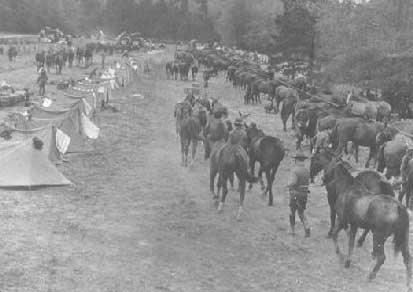
cavalry-horses

I wanted a way to thread history together, and looked for clues in the gilded pages of those ill-fated history books. A cohesive clue must be discoverable in all those old books, something nearly universal to all humanity. Perhaps an invention like the wheel, maybe music, or clothing, or food … if there were only some common link somehow obscured and hidden within all these colorful pages with their images of countless horses…

Horsemanship is a Mirror of Civilization

Chariots of early history (16th century BC)

This is my third “Mirror” post in a row, and where I finally explain the use of the metaphor and close the barn door after it.

In the first post of this Mirror trilogy, I mentioned becoming interested in reading about history while browsing the shelves of the doomed used bookstores in Harvard.

I didn’t and don’t have answers about what history people should remember, or what conclusions should be drawn. I am simply interested in knowing about factual history and discussing it. That interest led to the idea of The Legend of the Great Horse trilogy.

My blog’s “Mirror” Trilogy Concludes

Horses were a common factor in almost every time from primitive man and antiquity to the Renaissance and the American West. The animal has literally been with mankind every step of the way. As someone who competed in equestrian sports and worked in the horse industry, I found this to be an example of common knowledge not commonly explored.

Horsemanship was not an obvious process to humanity: it took thousands of years for mankind to learn to control a horse as a rider. While the first uses of horses are misty and inconclusive, truth be told early horsemanship was a dog’s breakfast of nose-rings, superstition and brutality.  So poor were the prospects of the first mounted riders ending up where (and how) they wished to arrive, that as a practical matter driving appears to have been the main use for horses in the early days of civilization.

This changed in the last millenia B.C. with a new kind of horsemanship based on working with the horse in an empathetic and humane way. The horse responded to empathetic methods so well that the new art, today called “dressage,” led to a revolution in mounted riding. As the human consciousness arced up our horsemanship advanced to new levels of cooperation and partnership.

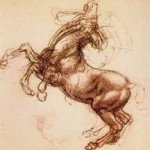
da Vinci's "Rearing Horse"
da Vinci’s “Rearing Horse”

However, when Rome fell into centuries of brutalized Dark Ages, dressage was lost to Western Civilization. In fact, dressage was one of the “rediscovered” Classical arts that sparked the new age of the European Renaissance. Riding schools were set up and Riding Masters emerged as students in the laboratory of the ménage. Horsemanship recovered its humane component and advanced to unprecedented heights of sport and art.

The history of horsemanship seems to highlight the relationship between empathy and human progress. It is fascinating to see how horses have adapted to the different stages of human development; horses are not only a true link with our past but a reflection of their times. Progress in horsemanship has mirrored the progress of mankind itself.

It makes for a fascinating study–and the greatest canvas on which to tell a story.

“On the Rocks” | Horses in Cave Art

This post begins a timeline to discuss the various eras traveled in “Eclipsed by Shadow,” and the rest of “The Legend of the Great Horse” trilogy. The first era is Pre-History.

Man’s long, colorful relationship with the horse is revealed in one of humanity’s oldest creative impulses: Art.  The equine image has adorned virtually every medium of artistic conception throughout history, from prehistoric caves and pottery to paintings, sculpture, music, and literature. Even in our modern automated age, horses have made the successful leap to electronic “new media” of teevee, film and video games.

From a historical perspective, it is fascinating to realize how much retained knowledge of our past is owed to art. The consciousness of a culture is embedded in the art it leaves behind, and artwork is painstakingly preserved for posterity. Horses have stirred human imagination since before recorded history, so art tells the story of horsemanship—and civilization—in a comprehensive visual thread.

The earliest art is the cave painting, and horses are a predominate theme. These prehistoric images give bright glimpses into the shadows of humankind’s veiled beginnings—surviving samples date back over 30,000 years. “Rock art” is famous for depictions of horses and other animals central to the world of primitive man, and some of the prehistoric images reveal genuine artistic quality. The purpose for these drawings is unknown, but various possibilities include the recording or transmission of information, religious ceremonies or superstitious “magical” rites. Whatever the explanation, cave art represent first rays of creative light peering out before the dawn of civilization.

Most cave paintings are crude, but there exist works that rise above mundane scratchings. The most sophisticated and “sublime” cave paintings transcend time, revealing an artistic spirit already intact in pre-historic man. It is as if art truly does touch upon some indefinable and ageless spark of the cosmos. As Pablo Picasso himself said upon viewing the famous Lascaux caves, “We have discovered nothing.”

Copyright © 2008 John Allen Royce, Jr.

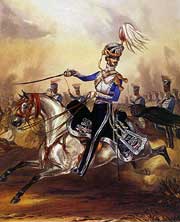
The Paradox of Horses in War

One thing you notice when researching historical fiction like “Eclipsed by Shadow” is how much human history is owed to the horse. Civilization advanced through adapting to the horse’s outlook.

Horsemanship is a civilized encounter with an alien mind. Horses are a “prey” species whose code is: “he who quickly runs away, lives to run another day.” The horse is perpetually alert, suspicious and ready to flee, and 6000 years of domestication have not changed this basic instinct.

The horse is an unlikely creature to ride into the chaos of battle, yet no animal so conjures the image of war. Horsemanship is one of mankind’s oldest and most perfected technologies, and the battlefield was its testing ground for thousands of years. It would seem an impossible feat to ask a timid, flighty animal to carry men into a smoking, stinking cacophony of fire and noise—yet that is exactly the result needed, and produced.

The Book of Job in Bible has a passage which relates this paradox.

“Hast thou given the horse strength?
Hast thou clothed his neck with thunder?
Canst thou make him afraid as a grasshopper?”

Of course the horse is only an instrument; war is an invention of man. Strangely, the speed and physical strength of the animal made him a formidable weapon, but the great challenge of horsemanship through the ages was how to get this four-legged weapon onto the battlefield at all. Anyone who has seen a horse “shy” or bolt in terror from a blowing leaf will understand the achievement of enlisting cooperation from what is essentially a saddled rabbit.

Skittishness in horses varies between individuals and isn’t completely explainable, as with Saki’s famous “Brogue,” a horse so named “in recognition of the fact that, once acquired, it was extremely difficult to get rid of.” According to the author’s description: “Motors and cycles he treated with tolerant disregard, but pigs, wheelbarrows, piles of stones by the roadside, perambulators in a village street, gates painted too aggressively white, and sometimes, but not always, the newer kind of beehives, turned him aside from his tracks in vivid imitation of the zigzag course of forked lightning.”

The secret of man’s partnership with the horse is trust. A wild band of equines operates through friendships and roles, and with proper instruction the trained horse learns to place his rider in the leadership position. This trust must be earned through the process of schooling, and can easily be lost, but it is one of the miracles of riding that only through an exchange of trust can the incredible potential of a horse’s ability be unlocked.