
- Chariots of early history (16th century BC)
This is my third “Mirror” post in a row, and where I finally explain the use of the metaphor and close the barn door after it.
In the first post of this Mirror trilogy, I mentioned becoming interested in reading about history while browsing the shelves of the doomed used bookstores in Harvard.
I didn’t and don’t have answers about what history people should remember, or what conclusions should be drawn. I am simply interested in knowing about factual history and discussing it. That interest led to the idea of The Legend of the Great Horse trilogy.
My blog’s “Mirror” Trilogy Concludes
Horses were a common factor in almost every time from primitive man and antiquity to the Renaissance and the American West. The animal has literally been with mankind every step of the way. As someone who competed in equestrian sports and worked in the horse industry, I found this to be an example of common knowledge not commonly explored.
Horsemanship was not an obvious process to humanity: it took thousands of years for mankind to learn to control a horse as a rider. While the first uses of horses are misty and inconclusive, truth be told early horsemanship was a dog’s breakfast of nose-rings, superstition and brutality. So poor were the prospects of the first mounted riders ending up where (and how) they wished to arrive, that as a practical matter driving appears to have been the main use for horses in the early days of civilization.
This changed in the last millenia B.C. with a new kind of horsemanship based on working with the horse in an empathetic and humane way. The horse responded to empathetic methods so well that the new art, today called “dressage,” led to a revolution in mounted riding. As the human consciousness arced up our horsemanship advanced to new levels of cooperation and partnership.
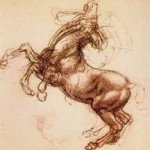
- da Vinci’s “Rearing Horse”
However, when Rome fell into centuries of brutalized Dark Ages, dressage was lost to Western Civilization. In fact, dressage was one of the “rediscovered” Classical arts that sparked the new age of the European Renaissance. Riding schools were set up and Riding Masters emerged as students in the laboratory of the ménage. Horsemanship recovered its humane component and advanced to unprecedented heights of sport and art.
The history of horsemanship seems to highlight the relationship between empathy and human progress. It is fascinating to see how horses have adapted to the different stages of human development; horses are not only a true link with our past but a reflection of their times. Progress in horsemanship has mirrored the progress of mankind itself.
It makes for a fascinating study–and the greatest canvas on which to tell a story.