How Horsemanship Drove the Progress of Civilization

Our relationship with the horse predates literacy, but both tomb relics and modern records agree that most of history’s leading societies possessed the highest skill in horsemanship. Clearly there is more to a horse than meets the eye.

Equestrian skill was important for prowess in battle, and advantage could be attained by advances in horse care, riding, training, breeding, equipment, etc. The horse represented potential for producing enormous gains in productivity, and societies best at tapping that potential were the most successful.
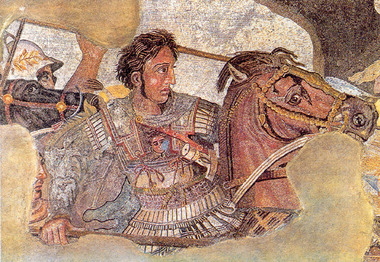
The Spanish Conquistador Cortez

One of the earliest civilizations, the Hittites, were a society known for their ability in building and using chariots, and grew to dominance in the 18th Century BC. Hittites were bested by Egyptians who used a new, lighter chariot design in the Battle of Kadesh in 1274, which was an epic Ancient World clash involving an estimated 5,000 chariots.

The Egyptians were eclipsed by the Greeks, and a superior philosophy of horsemanship may well have played a role. The Greek general Xenophon wrote On Horsemanship, the earliest surviving work on empathetic riding we now call dressage, which explains the humane method of schooling which produced their victorious cavalry.

Horsemanship fell to brutality in the Dark Ages, a symptom of a weakness the equine-centered Mongolian tribes under Genghis Khan were able to exploit as they overran Europe, India and the Middle East in the 13th century with huge armies of light horses.

Xenophon’s “On Horsemanship” was re-discovered in the 1400’s and helped ignite an interest in Classical thought which led to the Renaissance. 15th century Spaniards romanticized riding and treated it as an art form—a revolution of ideas from the brute servitude of Middle Age mounts—and their superior horsemanship was marked with triumph in the age of Conquistadors.

The 16th century Riding Master Pluvinel helped France take the lead in the equestrian arts with the development of the Haute Ecole, or High School of dressage, and the famous Airs Above the Ground. Today the contest continues in the form of international equestrian sport, where success still serves as a metaphor for a nation’s predominance.
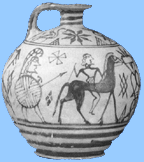
The Long, Colorful Road of Horsemanship

The Legend of the Great Horse traces horsemanship from its earliest beginnings. The premise of the story is that Meagan, a horse-interested teenager of modern day, is whisked back in time to relive history … on horseback. As she travels in “jumps” from the earliest days of man’s association with horses, Meagan and the reader experience the changes in horsemanship that mirrored the advance of civilization.

A hallmark of skilled modern riding is that it looks “easy,” but it has not always been this way. The casual spectator watching well-groomed horses cantering a jumping field or half-passing down the centerline may be forgiven believing things such as “the horse is doing all the work” or “anyone could do it” etc. Riding looks easy when done well because the rider remains in balance with the horse, maintaining a fluid rhythm with the mount’s athletic motion. This is not how horsemanship has looked through most of history, and nothing we now take for granted about riding was obvious or simple for humans to discover.

The "Greek Seat"
The “Greek Seat”

The origins of horseback riding are lost in the mists of time, but using the horse to pull wagons, carts and chariots represented the first phase of practical horsemanship. Mounted horsemanship does not appear in clear view until antiquity, and after at least 3000 years of development it wasn’t terribly impressive. The horses were guided with nose-rings by a rider who sat far back toward the horse’s hindquarters, though the Greeks modified this by inching forward to sit on the middle of the horse’s back. It literally took the human race thousands of years to discover where, exactly, to properly sit on horseback.

To humans, horses possess an alien mind, and what seems obvious today was not “obvious” at all. As one example, stirrups were not invented until after the fall of the Roman Empire—which itself was more than 25,000 years from the days that prehistoric man’s preoccupation with the animal was shown by painting in caves. First came a “toe loop” which developed in India (c. 500BC) for the holding of the rider’s big toe. A few centuries later nomadic “Sarmatians” of southern Russia and the Balkans invented a single stirrup for use in mounting. Over the next half-millennium, Asia brought the stirrup to fruition; it was copied by Europeans and revolutionized war.

One might consider that our ancestors were not the most clever ponies in the stable, but the reason for the long period of development was that advanced horsemanship required changes in mankind’s thinking. As humanity grew sufficient empathy to discover advanced horsemanship, the modern world also began a rapid transformation into the modern age.

The Pegasii

The flying horse Pegasus is one of Western culture’s most popular and durable myths. What may be surprising to many is that the idea of a winged horse is not isolated to Greek mythology, but is a universal notion in ancient religion.

The theme of my new trilogy, The Legend of the Great Horse, is the depth of man’s partnership with horses and the animal’s foundational importance to civilization. When discussing the influence of horses it is almost impossible to throw too wide a net, and the legend of a winged horse is an example.

Pegasii
Pegasii

Early Christianity was combined with the Sun-worshipping belief that the Emperor departed earth upon his death in a chariot pulled by winged immortal horses, and various beliefs herald the Second Coming of Christ upon the winged horse Avatar. Islam records the gift to Adam of the winged horse Mamoun. Hindus honored Vivasvat, the Seven-Headed Sun Horse that symbolized the workings of the Seven Chakras. Buddha was said to have flown across the heavens as a white horse, and both Norse and Celtic religions had a stableful of supernatural mounts.

In modern times, mythology is remembered as a group of fantasy stories involving the gods of Olympus and exotic animals like the Chimera, Basilisk, Hydra, along with soaring Pegasus. But in the time of their practice, the “mythology” of the Greeks was their religion: a complex, inter-woven, often conflicting world enmeshed with the natural. The gods lived upon Mt. Olympus: their home could be seen by Greek villagers carrying on their daily lives.

Today’s popular conception of mythology is a pale summary of the original. We may have learned that Pegasus was a gift from the gods, or that the flying horse was the mount of Zeus with hoofbeats which caused thunder. But it is less remembered that the first gift of a horse was rejected by the people of Athens in favor of Athena’s offering of an olive tree, one of antiquity’s great examples of the wisdom of choosing butter (olive oil) instead of guns (cavalry). It is forgotten in popular imagination that that Pegasus sired a race of immortal winged horses, the Pegasii; or that Pegasus had a brother named Celeris, the mount of one of the Geminii twins (Castor, “The Horseman”) who were honored as a cult by the legions of Rome, and given placement, as was Pegasus, in his own constellation: The Colt.

The immortal Pegasii were of many colors, not only white, and they had varying powers of transport and appearance and purpose. The Pegasii were associated with dreams and inspiration, and all were benefactors of mankind or agents of the natural world.

The “legend” of Eclipsed by Shadow and the rest of The Legend of the Great Horse trilogy concerns the strangely universal idea that horses were gifted to man by the Creator. The “Great Horses” of history are descended from this first horse. Promise, the Great Horse belonging to the book’s main character, Meagan, shares the essential characteristics of the Pegasii.

Researching “The Legend of the Great Horse”

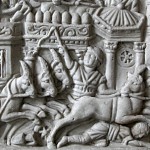
Ancient stonework of a chariot accident

The Legend of the Great Horse trilogy takes place across many historical eras, from pre-history to modern times, and research was fundamental to telling the most accurate story I could. I followed a method I found enjoyable and fascinating, and it’s one I believe brought authenticity to the work.

Basically, I gathered writings from each era visited in the book, and spent significant time immersing myself in that culture. The thoughts and emotions of a literate society are reflected in its writing, and I found that by experiencing (reading) a variety of preserved texts a picture of the society could surface. I found a lot of surprises.

For example, one of the historical periods visited in Eclipsed by Shadow is ancient Rome. There’s no shortage of writing from our Roman ancestors, but there is a profusion of literary works of quality during the late Republic and early days of Empire. The first “novel,” Satyricon, was written then, and also the historical works of the great chronicler Tacitus. Reading facts about Rome along with works of Romans themselves reveals their world in a new and authentic way—through the eyes of our ancestors.

I learned how Rome grew as a new idea in the hearts of man: one of shared citizenship and the power of harmony. This early melting pot of foreign peoples was gradually corrupted by ongoing appeal to military virtues and primacy of commerce. Well, that’s a bit foreboding.

Tacitus was a former Consul who lived through nine emperors; he wrote bravely as his world was descending into debased madness that eventually ended in annihilation. Western civilization—the one I live in—literally died once before. If I’d been taught this history, I didn’t fully appreciate it in those terms.

I hope that my research provides the reader with something valuable and different in their knowledge of the world. The experience changed me. History is not always what it seems, and it is certainly not a closed book.