Horses and the Dark Ages of Man

Horses may have pulled and carried humanity up the long ascent from primitive cultures, but it wasn’t a straight line. Human societies have been subject to cycles of  falling away from civilized life.

“Dark age” describes the lack of historical records from these periods, such as during the Bronze Age collapse about 1200 BC, which ended the Mycenaean culture and extinguished literacy for several centuries.

The most recent “dark age” of Western culture was the approximately 1000 years after the collapse of ancient Rome, or the Middle Ages. The wonders of ancient Rome included heated public Baths,  running water and vast entertainments — the Middle Ages were marked with mud roads, illiteracy, poverty and disease.

What does this have to do with horses?

Horsemanship has been a slow road of progress from brutal subjugation to humane partnership. Understanding the horse, an excitable prey animal, has been a major exercise in empathy for human culture.

A new idea of riding was discovered by the ancient Greeks we now call dressage, which emphasizes the cooperation of the horse rather than forced submission. Dressage develops a harmonious partnership with the horse and provides greater control, balance and athleticism.

This civilized form of riding was lost during the Middle Ages; as humans reverted to illiteracy and brutality their riding became brutal as well.

It’s interesting to note that dressage was one of the earliest classical arts to be reborn in the European Renaissance. The return of humane horsemanship to the world coincided with the birth of the modern era in about the 17th century — not so long ago.

In a sense, good horsemanship is a celebration of empathy, and perhaps a barometer of its presence. Our relationship with the horse started before recorded history, but the goal of humane partnership as practiced today is only a few centuries old!
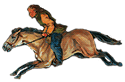
Meagan Roberts, Hero

The heroine of The Legend of the Great Horse trilogy is resourceful, quick-witted and brave … her name is Meagan Roberts.

The trilogy follows the development of horsemanship in human history, and horses have given the world such rugged male icons as cowboys (and indians), knights in shining armor and cavalry charges, not to mention Ben-Hur. Yet my initial main character “Michael” kept dismounting to let Meagan aboard.

The story concerns a modern-day rider, and it is an unfortunate fact that young men in America today do not dedicate themselves to horsemanship in nearly the numbers that young women do … this comes after the majority of human history depicted horsemanship as a strictly male pursuit. Times change and horsemanship changes with it.

Discovering and writing a female hero was natural enough, as my former experience teaching riders meant coaching battalions of young women for every male. My idea for Meagan is the young college student who stays up all night grooming horses in return for a trailer ride to the next day’s competition. Meagan is the excited young girl whose straight-A report card finally convinces a carpool-weary parent to add one more stop at the stables. She is the shy adolescent whose eyes light up with confidence after a good round, the dependable ingénue who quietly keeps herself and her horses glowing, the serious junior who quietly listens and plans her way to success.

Horseback riding has historically been a respected, even hallowed method of youth development, turning out thoughtful, responsible leaders with empathy and depth of character for millennia. Meagan is a compilation of the qualities that horsemanship imparts: she is resourceful, diligent, fair-minded, and brave, and able to lead while engaging in both teamwork and strategic planning. These heroic qualities are all human virtues to be improved in the sandy classroom of our great teacher: the horse.

Chariot Racing Lives!

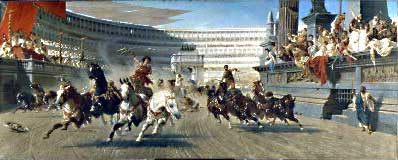
“The Chariot Race” (1882) by Alexander von Wagner

A goal of mine when writing “Eclipsed by Shadow” was to introduce lesser-known history and discuss it in new ways. Roman chariot racing signaled something new to humanity with far-reaching implications, and it was the phenomenon that made me aware of the central role horsemanship has truly played in the development of civilization.

Ancient Rome is important for its lessons. Western civilization traces its roots to the Greek and Roman societies of antiquity, and those roots are far more than entertaining echoes in our own time. In “Eclipsed by Shadow” I note: “Rome had advertising, taxes, courts and contracts, free market capitalism, corporations, seven-day weeks, holidays, welfare, organized religion, spectator sports, running water and sewers, fine roads, literature, cultural arts, and a well-run military—none of this would save them.”

There was much that was good about Rome in its early centuries. Their society grew the world’s first Middle Class, and instituted a representative form of government complete with a Senate, elected politicians and a system of law. Yet it is the unhappy fact of Rome that they corrupted and became something that destroyed human conscience and pitched Europe into brutal centuries of Dark Ages.  Western Civilization has died once before.

The tragedy of Rome is that they were doomed by forces mankind had never encountered before, because they were something new under the sun. At its height, Rome offered its citizens a standard of living not seen again until the middle 1700’s—more than 12 centuries of brutal squalor in Europe lay between the fall of Rome and the Enlightenment. It is not a path to tread again.

One of the forces that Rome unleashed was fanaticism, and it happened through chariot racing.

Horsemanship is a Mirror of Civilization

Chariots of early history (16th century BC)

This is my third “Mirror” post in a row, and where I finally explain the use of the metaphor and close the barn door after it.

In the first post of this Mirror trilogy, I mentioned becoming interested in reading about history while browsing the shelves of the doomed used bookstores in Harvard.

I didn’t and don’t have answers about what history people should remember, or what conclusions should be drawn. I am simply interested in knowing about factual history and discussing it. That interest led to the idea of The Legend of the Great Horse trilogy.

My blog’s “Mirror” Trilogy Concludes

Horses were a common factor in almost every time from primitive man and antiquity to the Renaissance and the American West. The animal has literally been with mankind every step of the way. As someone who competed in equestrian sports and worked in the horse industry, I found this to be an example of common knowledge not commonly explored.

Horsemanship was not an obvious process to humanity: it took thousands of years for mankind to learn to control a horse as a rider. While the first uses of horses are misty and inconclusive, truth be told early horsemanship was a dog’s breakfast of nose-rings, superstition and brutality.  So poor were the prospects of the first mounted riders ending up where (and how) they wished to arrive, that as a practical matter driving appears to have been the main use for horses in the early days of civilization.

This changed in the last millenia B.C. with a new kind of horsemanship based on working with the horse in an empathetic and humane way. The horse responded to empathetic methods so well that the new art, today called “dressage,” led to a revolution in mounted riding. As the human consciousness arced up our horsemanship advanced to new levels of cooperation and partnership.

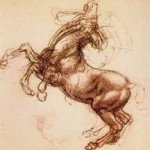
da Vinci's "Rearing Horse"
da Vinci’s “Rearing Horse”

However, when Rome fell into centuries of brutalized Dark Ages, dressage was lost to Western Civilization. In fact, dressage was one of the “rediscovered” Classical arts that sparked the new age of the European Renaissance. Riding schools were set up and Riding Masters emerged as students in the laboratory of the ménage. Horsemanship recovered its humane component and advanced to unprecedented heights of sport and art.

The history of horsemanship seems to highlight the relationship between empathy and human progress. It is fascinating to see how horses have adapted to the different stages of human development; horses are not only a true link with our past but a reflection of their times. Progress in horsemanship has mirrored the progress of mankind itself.

It makes for a fascinating study–and the greatest canvas on which to tell a story.