 Though horsemanship is ancient, Show Jumping itself is one of the world’s youngest professional sports!
Organized jumping is barely 100 years old. It was not known that horses could jump large fences until the 18th Century, when fox hunting was threatened by the Enclosure Laws that fenced previously open land.
A century ago we seemed to be at the end of our ancient partnership with the horse, since the animal’s use in transportation was made obsolete by the invention of the internal combustion engine. Today there are more horses than ever, largely due to equestrian sport and recreation … and one of the big drivers of that growth is the international sport of Show Jumping.
So it is great news to hear of the sport’s continuing success as a spectator attraction, as was seen last week at the Canadian jumping hot-spot of Spruce Meadows in Calgary. A record crowd of over 70,000 spectators attended the closing Masters competition, many waiting in lawnchairs at 6:00am to secure the best seats. Congrats to Spruce Meadows for its great work, and for proving that Show Jumping can be a spectator sport for the future.
 A new
A new 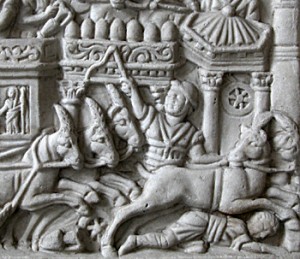 Naufragia was ultimate disaster, an end not only to hopes of victory but to lives, careers, destiny. A favorite champion could be undone in an instant—every moment of a chariot race was fraught with potential disaster. The extremes of emotion provoked by collisions and near disasters shocked spectators into wild states of euphoria and despair.
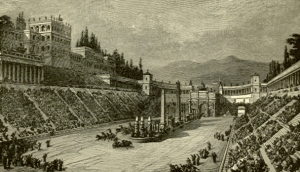 In our modern society we have celebrity athletes of different sports, but this is not simply a continuation of historical tradition. Rome was the society that first grew athlete-superstars was Rome. After their collapse, Europe endured a period of centuries known as the Dark or Middle Ages in which there were no celebrity athletes. It was not until the Industrial Age and the organization of modern sports that athletes began to again capture the popular imagination as celebrated stars.