#44- Into the darkness (700 BC) …

THE DROP WAS not far, not more than ten feet. For a time Meagan lay with her eyes and hands clenched shut, trying to make sense of recent events. Slowly she opened her eyes and let her vision adjust to the dim light around her. A hoof stood inches from her face. – Eclipsed by Shadow excerpt

One of the riders stopped on the ground below…

Until that moment Meagan had been too stunned for fear, but she looked into the man’s slitted eyes and backed away from the edge. He saw her. The rider’s thin arm motioned and an object whistled past her. Two yards away a spear jabbed into the bare ground. Its end rocked. Another spear shot up. Meagan scuttled for the center pit as the new missile streaked overhead. She caught the edge of the pit and lowered herself, kicking for a peg. Another spear arced up, but she did not wait to see where it fell.

She stepped down, bare foot waving until she found a peg. Heavy air insulated the sounds of battle as she descended the dim tunnel. One peg gave slightly and shifted. Meagan froze. She flattened against the side of the pit, testing the nub with her weight. With a sudden twist Meagan’s support was gone. For a brief second she hung in space, scrambling against the scraped earth, kicking dirt away before she fell.

* * * *

THE DROP WAS not far, not more than ten feet. For a time Meagan lay with her eyes and hands clenched shut, trying to make sense of recent events. Slowly she opened her eyes and let her vision adjust to the dim light around her. A hoof stood inches from her face. Meagan jerked away, but another solid limb pressed unyieldingly into her back. She was surrounded by a forest of horses’ legs.

Excerpted from Eclipsed by Shadow, the award-winning 1st volume of “The Legend of the Great Horse” trilogy. (Hrdbk pg. 106)

Book II: The Golden Spark will be published Fall 2010.

Read the 1st Chapter online!

Copyright © 2008 John Royce
The Paradox of Horses in War

One thing you notice when researching historical fiction like “Eclipsed by Shadow” is how much human history is owed to the horse. Civilization advanced through adapting to the horse’s outlook.

Horsemanship is a civilized encounter with an alien mind. Horses are a “prey” species whose code is: “he who quickly runs away, lives to run another day.” The horse is perpetually alert, suspicious and ready to flee, and 6000 years of domestication have not changed this basic instinct.

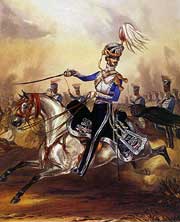
The horse is an unlikely creature to ride into the chaos of battle, yet no animal so conjures the image of war. Horsemanship is one of mankind’s oldest and most perfected technologies, and the battlefield was its testing ground for thousands of years. It would seem an impossible feat to ask a timid, flighty animal to carry men into a smoking, stinking cacophony of fire and noise—yet that is exactly the result needed, and produced.

The Book of Job in Bible has a passage which relates this paradox.

“Hast thou given the horse strength?
Hast thou clothed his neck with thunder?
Canst thou make him afraid as a grasshopper?”

Of course the horse is only an instrument; war is an invention of man. Strangely, the speed and physical strength of the animal made him a formidable weapon, but the great challenge of horsemanship through the ages was how to get this four-legged weapon onto the battlefield at all. Anyone who has seen a horse “shy” or bolt in terror from a blowing leaf will understand the achievement of enlisting cooperation from what is essentially a saddled rabbit.

Skittishness in horses varies between individuals and isn’t completely explainable, as with Saki’s famous “Brogue,” a horse so named “in recognition of the fact that, once acquired, it was extremely difficult to get rid of.” According to the author’s description: “Motors and cycles he treated with tolerant disregard, but pigs, wheelbarrows, piles of stones by the roadside, perambulators in a village street, gates painted too aggressively white, and sometimes, but not always, the newer kind of beehives, turned him aside from his tracks in vivid imitation of the zigzag course of forked lightning.”

The secret of man’s partnership with the horse is trust. A wild band of equines operates through friendships and roles, and with proper instruction the trained horse learns to place his rider in the leadership position. This trust must be earned through the process of schooling, and can easily be lost, but it is one of the miracles of riding that only through an exchange of trust can the incredible potential of a horse’s ability be unlocked.

How Horsemanship Drove the Progress of Civilization

Our relationship with the horse predates literacy, but both tomb relics and modern records agree that most of history’s leading societies possessed the highest skill in horsemanship. Clearly there is more to a horse than meets the eye.

Equestrian skill was important for prowess in battle, and advantage could be attained by advances in horse care, riding, training, breeding, equipment, etc. The horse represented potential for producing enormous gains in productivity, and societies best at tapping that potential were the most successful.

The Spanish Conquistador Cortez

One of the earliest civilizations, the Hittites, were a society known for their ability in building and using chariots, and grew to dominance in the 18th Century BC. Hittites were bested by Egyptians who used a new, lighter chariot design in the Battle of Kadesh in 1274, which was an epic Ancient World clash involving an estimated 5,000 chariots.

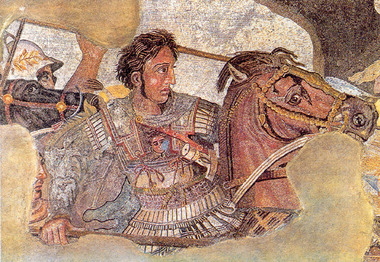
The Egyptians were eclipsed by the Greeks, and a superior philosophy of horsemanship may well have played a role. The Greek general Xenophon wrote On Horsemanship, the earliest surviving work on empathetic riding we now call dressage, which explains the humane method of schooling which produced their victorious cavalry.

Horsemanship fell to brutality in the Dark Ages, a symptom of a weakness the equine-centered Mongolian tribes under Genghis Khan were able to exploit as they overran Europe, India and the Middle East in the 13th century with huge armies of light horses.

Xenophon’s “On Horsemanship” was re-discovered in the 1400’s and helped ignite an interest in Classical thought which led to the Renaissance. 15th century Spaniards romanticized riding and treated it as an art form—a revolution of ideas from the brute servitude of Middle Age mounts—and their superior horsemanship was marked with triumph in the age of Conquistadors.

The 16th century Riding Master Pluvinel helped France take the lead in the equestrian arts with the development of the Haute Ecole, or High School of dressage, and the famous Airs Above the Ground. Today the contest continues in the form of international equestrian sport, where success still serves as a metaphor for a nation’s predominance.