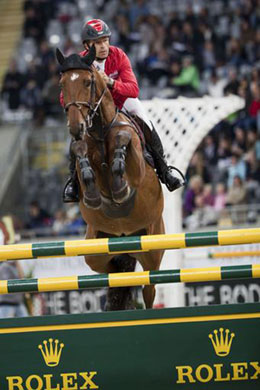
Why Show Jumping?

By John Royce – My new project Clean-Round.com and many of my online shares are about Show Jumping rather than other horse sports I also love … I’d like to explain.

What some might call an unreasonable passion in my life has been to help connect people with horses in the modern era. My first love was Western and I believe there is no greater spectacle in sport than international Eventing’s cross-country. I respect Dressage’s empathetic quest for unity as both art and a hallowed touchstone of human progress. I enjoy watching Polo and see Driving as a moving homage to history and tradition. I love the races. It’s all good…
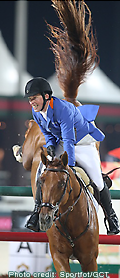
Gerco Schröder riding LONDON in the Gucci Grand Prix of Abu Dhabi - Photo: Sportfot/GCTThe reason I focus on show jumping is that it has three basic qualities that, in my view, give it the potential to connect an ‘un-horsed’ populace with its ancient legacy of horsemanship.

(1) As a necessary first condition, show jumping is humane and promotes higher standards in horse care, training and riding. Though not without issues, the official sport is zero-tolerance for drugs, abuse, or horse endangerment, including lameness or other pain. Beyond the rules, the challenge of jumping itself mitigates against bad treatment: horses do not jump well when afraid or uncomfortable. Bad behavior happens in any human endeavor, but in show jumping abuse is a path to injury and wasted investment—not success. The sport is beneficial to both horses and people, and inclines to the positive.

(2) The sport is amazingly adaptable to modern life. Though very young—the roots of horse jumping date only from the mid-18th Century—show jumping has now been contested all around the world on all kinds of surfaces, natural and artificial, from dirt lots to tanbark, snow, sand, and turf. The format is flexible and varied, with multiple levels of competition for all ages, both sexes and a wide accommodation of skill levels and economic backgrounds. It fits into spaces from small arenas to large stadiums, rural to urban, indoor and outdoor. The challenge of show jumping can be modified to meet a wide range of conditions and specifications.

(3)The third reason I share about show jumping is something rather unique in equestrian sport: it was conceived and created as a public spectator attraction. The sport was formed by accident, in response to spectator requests. Obstacles scattered across the countryside were brought in to include the audience—and something magical occurred. The spectacle became sport, and more than that, it became a game the horse understood and would play with us. People don’t watch sport so much as they watch games … and by being a game, when presented well, the sport can connect millions of people to the excitement and beauty of horses. Spectator interest has been integral to show jumping from its inception to its success today, and is a foundation which can be built upon.
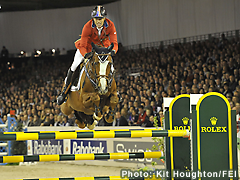
Rich Fellers (USA) riding Flexible winner of the Rolex FEI World Cup™ Final 2012. - Photo: Kit Houghton/FEIIt’s true the sport has had growing pains and problematic historical legacies and associations. Show jumping may not be quite ready for prime time in some ways: but it can be made ready, and along the way do a great deal of good for horses and (imo) greater humanity.

Humane benefits, flexibility to adapt to the modern era, and because spectator interest is intrinsically part of the sport–these are the reasons why I focus on sharing about Show Jumping!
Crossposted on Facebook

Olympic Show Jumping’s Team Competition: The Nations Cup

Horsemanship mirrors society, and show jumping’s Olympic Nations Cup still serves to measure of the spirit and strength of the countries of the world.

Until the Los Angeles Olympics in 1984, the Nation’s Cup of Show Jumping was the final event held on the last day in the Main Stadium.

The ruling bodies of Olympic sport have currently placed the competition in the middle of the games. The Nations Cup is still of attention for several reasons.

Jumping is recent knowledge

Though equestrian sport is ancient, Jumping is a very young competition. After the first contests were held in the mid-1800’s, it was largely the military that fielded horses and riders–for the very good reason that the highest levels of horsemanship were practiced by cavalry. Jumping was a new challenge in horsemanship that highlighted the best military training.

Officers came together to compete before the public in a team competition that became the Nations Cup. These international competitions originally were much as air shows today: advanced technology of the armed forces. Because cavalry quality often foretold success on the battlefield, there was special meaning attached to national success on the jumping field.

The Olympic Spirit Exemplified

The first formal Nations Cup was held at the Olympics in 1912, and were limited to commissioned military officers until 1952.

Before the Los Angeles Games in 1984, the Olympics concluded with the Nations Cup because it stood for the Olympic spirit of contest through sport and not conflict. The tradition was ended as commercialization took hold and the Closing Ceremonies became more elaborate.

The original meaning of the Nations Cup has not changed however. Horsemanship mirrors society, and the Nations Cup serves as an exciting measure of the spirit and economic strength of countries of the world.

The Nations Cup and Rise and Fall of Nations

Olympic ringsThe placings of the Olympic Nations Cup recall the history of the 20th century. The top teams placings read like a who’s who of the world’s top nations rising and falling from the placings along with their economic and political strength.

The Nations Cup reflects the top of the world

This year’s London Olympic Games are especially interesting as new nations come forward.

South American nations are showing competitive strength. Sweden is asserting itself. Australia is producing top talent. Japan is once more taking part. Eastern Europe is becoming steadily more competitive.

A big story is a new jumping rival in the Middle East, as nations like Saudi Arabia and the UAE have entered the world arena.

Even China and India, not equestrian nations in modern times, are making moves into the Jumping arena …

The Nations Cup has many surprises and excitement. One of the most traditionally important and telling Olympic competitons is set to begin …

Helsinki International Horse Show

FEI_WC10_Oslo_Pius-SchwizerThe second European qualifier for the World Cup of Show Jumping was held over the weekend in Helsinki, Finland.

The on-fire Swiss rider Daniel Etter and his mount Peu a Peu won the event in a 10-horse jumpoff to match their World Cup Qualifier victory last weekend in Oslo. USA rider Lauren Hough on Quick Study took second only 1.08 seconds behind the leader, the best result for a US rider in this early season.

European World Cup Jumping is an exciting indoor series because of the large public crowds and media attention. Show jumping was originally developed in Europe and still leads the world in spectators and dynamic, innovative presentation of the sport.

World Cup Show Jumping: European League Opens in Norway

Meredith_Michaels_Beerbaum__ShutterflyThe European season of World Cup Show Jumping opened today in Oslo, Norway.

The World Cup is an extensive series of indoor qualifiers across the globe, leading to the Finals in April.

It is an interesting odd fact that horse jumping is a  young sport: the ability of horses to jump with a rider was not discovered until the 1700’s. This intriguing competition continues to grow in popularity worldwide. The Show Jumping World Cup series was only begun in 1978, and today the series is contested in 14 leagues on every continent.

In essence, Show Jumping’s World Cup is the sport’s annual international indoor championship. Since the 1950’s, Show Jumping has evolved into a year-round sport, and the tight, colorful, electric atmosphere of indoor jumping is very different than the galloping expanses of outdoor courses. Some horses go better indoors, some prefer outside–this difference in challenge makes for interesting jumping competition year-round.