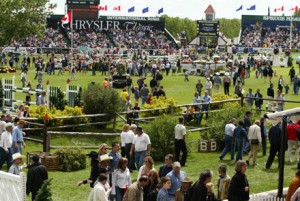
Record crowd of 73,736 attend Canadian Show Jumping Masters

Spruce Meadows arenaThough horsemanship is ancient, Show Jumping itself is one of the world’s youngest professional sports!

Organized jumping is barely 100 years old. It was not known that horses could jump large fences until the 18th Century, when fox hunting was threatened by the Enclosure Laws that fenced previously open land.

A century ago we seemed to be at the end of our ancient partnership with the horse, since the animal’s use in transportation was made obsolete by the invention of the internal combustion engine. Today there are more horses than ever, largely due to equestrian sport and recreation … and one of the big drivers of that growth is the international sport of Show Jumping.

So it is great news to hear of the sport’s continuing success as a spectator attraction, as was seen last week at the Canadian jumping hot-spot of Spruce Meadows in Calgary. A record crowd of over 70,000 spectators attended the closing Masters competition, many waiting in lawnchairs at 6:00am to secure the best seats. Congrats to Spruce Meadows for its great work, and for proving that Show Jumping can be a spectator sport for the future.
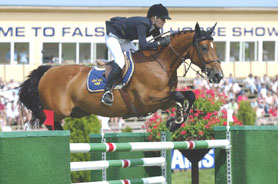
Show Jumping has a story to tell

I recently watched the live video feeds from two major international jumping events, The Syracuse Invitational and the Royal Winter Fair in Toronto. The horses look great, the riders are skilled, the competition level is high and humane. Both are well-run by innovative management.

The only lack was in the Announcing. Show jumping is like a storybook with pictures: it must be narrated. The story needs to be told.

Those who already love the sport will forgive transgressions against their spectator interests, but that is no reason for complacency. The key to creating new fans is engaging them.

Entertaining spectators at a horse show is as easy as talking to them about horses. This is not “easy” at all, in reality, as it requires talent combined with professionalism and love for horses and the sport. However, it would be pay great dividends for the sport to develop just such talent.

Horses & the Olympics

In writing Eclipsed by Shadow, I researched the history of the original Olympic Games and their relation to horses. The original Olympics were a religious ceremony, and were as much a poetry contest as a sporting event. The equestrian events were considered an athletic poem. They were a major focus of the original Games.

We have chosen to honor the “Olympics,” but there were actually four major Grecian Games, the Olympian, Pythian, Nemean, and Isthmian. These were held in yearly cycles, so that the largest Games near Olympia were held every four years. The equestrian events were the most popular and religiously significant. The contests included flat Racing, Dressage and Chariot Racing (today the sports are Dressage, Eventing and Jumping). Note that Dressage is the definition of “classical.”

The fact that the ancient Games were religious in nature has given a special moral character to the modern Olympic movement. There were two sports in the original Games: Athletics and Equestrian. Each type of competition held a specific meaning. Athletics represented the striving for human excellence, and Equestrian events represented man’s survival and conquest against the elements.

Inclusion of horses ennoble the Games, and the honorary aspect of equestrian sport is the origin of the famous “Olympic spirit.” The integrity of the Olympic ideal is upheld in the equestrian sport above all, for it is the horse which competes for no prize except the joy of taking part, and horsemanship which puts the mount’s welfare higher even than the Olympic rewards of money and fame.