New Hardback Edition of “Eclipsed by Shadow”

A lot has been happening with the book! The first news is that a hardback edition of Eclipsed by Shadow will be published in October. This will be a “library bound” edition (without a dust jacket) and has been re-typeset with illustrations added along with a new cover.

Some site enhancements will be in operation soon, including a media kit including press and image downloads, and after the hardback’s release blog postings will be syndicated to the book’s Amazon page.

Also, the trilogy’s e-newsletter will soon commence publication. This monthly email will keep readers in touch with book developments and provide notifications and discounts for future volumes. I invite you to subscribe to the newsletter (and guarantee privacy of your email address).

I’m looking forward to posting more topics soon … thanks for stopping by!

Researching “The Legend of the Great Horse”

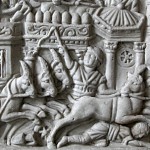
Ancient stonework of a chariot accident

The Legend of the Great Horse trilogy takes place across many historical eras, from pre-history to modern times, and research was fundamental to telling the most accurate story I could. I followed a method I found enjoyable and fascinating, and it’s one I believe brought authenticity to the work.

Basically, I gathered writings from each era visited in the book, and spent significant time immersing myself in that culture. The thoughts and emotions of a literate society are reflected in its writing, and I found that by experiencing (reading) a variety of preserved texts a picture of the society could surface. I found a lot of surprises.

For example, one of the historical periods visited in Eclipsed by Shadow is ancient Rome. There’s no shortage of writing from our Roman ancestors, but there is a profusion of literary works of quality during the late Republic and early days of Empire. The first “novel,” Satyricon, was written then, and also the historical works of the great chronicler Tacitus. Reading facts about Rome along with works of Romans themselves reveals their world in a new and authentic way—through the eyes of our ancestors.

I learned how Rome grew as a new idea in the hearts of man: one of shared citizenship and the power of harmony. This early melting pot of foreign peoples was gradually corrupted by ongoing appeal to military virtues and primacy of commerce. Well, that’s a bit foreboding.

Tacitus was a former Consul who lived through nine emperors; he wrote bravely as his world was descending into debased madness that eventually ended in annihilation. Western civilization—the one I live in—literally died once before. If I’d been taught this history, I didn’t fully appreciate it in those terms.

I hope that my research provides the reader with something valuable and different in their knowledge of the world. The experience changed me. History is not always what it seems, and it is certainly not a closed book.

“The Legend” explained

In the Beginning, Man so angered the Lord he was cast from the Garden. In the midst of the Lord’s wrath an Angel came onto Him. The Angel asked permission to lead Mankind back again to Paradise, and wished to be given a shape to best serve Man in his exile.

This love stayed the Lord’s wrath. The Four Winds swirled into a shape of beauty that moved to thunder … the Angel took form and became the first Horse.

(excerpted from Eclipsed by Shadow)

So begins “the legend” from The Legend of the Great Horse trilogy. Legends and myth shape the world of our imagination, and none is more universal than the belief that the horse is associated with the supernatural.

This idea is seen in Western Civilization’s own Greek myths of the winged horse Pegasus.

It is also found in Islam, where Mohammed’s horse Buraq made a great leap into Heaven which left a hoofprint still to be seen in Jerusalem … according to legend, that is.

“What’s a Dressage?”

It’s hard not to notice the disdain with which some sports watchers treat Dressage. They give silly quotes to media people that produce articles like: “Olympic dressage events leave Hong Kong’s horse racing fans yawning.”

Well of course they are yawning. You don’t get your Olympic thrills through eventing dressage, which is only more interesting than attractively-drying cement if it’s being done wrong. Olympic thrills are found on the next day, the Cross-County. Someone should have told the spectators, or at least the media. There is so much confusion in the world.

It is actually understandable that equestrian sports are such an oddity to the public, in spite of humanity’s millennia-old partnership with the animal. An uninitiated person would naturally assume modern equestrian sports have all existed since ancient times–in fact some of the most popular and exciting are hardly a century old.

It is an amazing bit of historical timing that an ancient skill like horsemanship was perfected to point it could conceive of athletic sports like 3-Day and Jumping … at the same time as the invention of automobiles. And today we have more horses than ever before.

Dressage, however, is truly as ancient as people assume all horseback riding is. It is a proven method of schooling horses that is at least 2500 years old. The origins were the battlefield, where discipline and athleticism were vital to cavalry success. Dressage is a gymnastics program for developing the horse’s physical abilities, and equally importantly, develops positive state of communication between the horse and rider. The system is utterly humane, to the degree of emphasizing only natural movements and requiring the horse be calm and relaxed at all times. Dressage is, in words of modern culture, the Jedi force that animates horsemanship. It is art, and there is magic in it.

Like all the arts, Dressage was lost with the decay of Western civilization during the Dark Ages. European Horsemanship disintegrated into barbarity as humanity lapsed into bestial conditions. The re-discovery of the ancient Classical art of Dressage was part of the earliest flowering of the Renaissance which sparked our current age.

There are multiple levels of dressage and as the levels go higher, the horse begins to develop more expressively until his gait becomes dancing. Some say dressage is like ballet, and as an educated art it is, though since dressage pre-dates ballet by over a millennium perhaps it is more accurate to say ballet is like dressage. (Dressage is also older than Classical music, that upstart.) The highest standard is the Grand Prix, exemplified in the competitive display of the Olympic Games. High level Dressage is a cultural event, as it was in the original Olympics themselves.

So that judge’s stand only looks like a bookie’s window, racing fans. I think the media gives too little credit to Hong Kong’s citizens. When Dressage is put to music at the final Freestyle, even racing fans may see the sparks which ignited during the Renaissance.