Benefits of Horses series on Horse Owner Today

Hyracotherium vasacciensis skeleton, National Museum of Natural History, Washington, D.C., USA. - Jeff Kubina / Wikimedia Commons / CC-BY-SA 2.0
Hyracotherium (formerly Eohippus) skeleton – Jeff Kubina / Wikimedia Commons / CC-BY-SA 2.0
I’m beginning an informal series on the benefits of horses to humans … Horse Owner Today magazine has posted the 1st one!
Excerpt


Watching Horses is part of being Human

To say mankind evolved watching horses is simply reporting evidence. Incredibly, the sight of horses is older to humanity than the use of fire … or even tools. Horse-watching by humans predates their even walking upright.

Into the Dark (Book #3): Encountering the reality of history

Into the Dark (bookcover) WWII cavalry horse Cavalrymen knew the situation: there were no waves of doomed galloping charges against superior weaponry as enemy propaganda claimed. However in countries such as Poland in the early days of WWII, there was no time to adapt, and tragic scenes of onslaught–metal against blood–gave mankind’s insensate use of horses in battle its final tragic setting. – Into the Dark: The Legend of the Great Horse (Book #3)

Into the Dark (bookcover) WWII cavalry horse
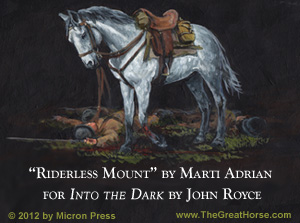
This bookcover image by Marti Adrian Gregory is perhaps the most difficult horse character of Into the Dark.

It is of a cavalry horse wounded on a WWII battlefield.


Horses on this battlefield probably did not suffer more than on others, but the ultimate folly of war was shown most clearly—and further folly too—as our ancient partner fell to man-made machines.

In the early 20th Century, the bright hope of liberating humanity from the tyranny of fanaticism, corrupt wealth and war was darkened by those same forces … in this era technological change swept away the last major remnants of mounted cavalry.

Horses were already being replaced by motorized horsepower when war came … the saying that ‘Generals always fight the last war’ was tragically played out as mounted units and draft animals mingled with tanks, artillery fire and aircraft.

Cavalrymen knew the situation: there were no massive waves of doomed galloping charges against superior weaponry as enemy propaganda claimed. However in countries such as Poland in the early days of WWII, there was no time to adapt, and tragic scenes of onslaught–metal against blood–gave mankind’s insensate use of horses in battle its final tragic setting.

The last part of “Into the Dark enters a recent historic change that seems to be already blended in memory with ages past; we are careless with our history. The scene is only three short pages, included because it was a turning point in the modern world that should not be forgotten.

Into the Dark (Book #3 of The Legend of the Great Horse) is to be published on July 20th, 2012 … the book’s new cover images and excerpts from the book will be shared in the run-up to the launch date…

How to Hunt a Horse

Sneaking around is the rule for horse-hunters… and it ain’t easy. As anyone who has spent time with horses knows, our silent partner is quite alert to potential lions in the flower-pots. The horse’s creed is “he who quickly runs away, lives to run another day,” and he instinctively knows his survival depends upon a good headstart.

Mostly, you don’t.  Horses are prey in the wild, but few predators dare confrontation with a healthy equine. You could call horses “extreme” prey.

stubbs, horse frightened by lion, 1770

The opening historical scene of Eclipsed by Shadow is set in prehistoric times, highlighting the earliest relationship between man and horse: hunter and hunted.

It was not our most enjoyable association, casting humans in the shabby role of trickster … and leaving the horses not too happy either.

The horse has few natural predators

Lions and wolf packs are the only major predators with horse on the menu, and they mostly avoid contact. As a horse’s kick can crush an adult lion’s skull — something we could call a ‘game-changer’ — the horse’s enemies remain on the lookout for immature, elderly or sick equines.

If hooves are the danger in horse-hunting, getting close to the animal is the difficulty. A horse may not have the sprinting take-off of a gazelle, but with a short headstart no predator on earth can catch him.

The horse’s anatomy is a balance between power and swiftness: his heavy body is balanced on thin, well-leveraged limbs that take a few strides to reach full speed but allow him to gallop for miles. The horse simply outclasses all predators at any real distance.

So sneaking around is the rule for horse-hunters … and it ain’t easy. As anyone who has spent time with horses knows, our silent partner is quite alert to potential lions in the flower-pots. The horse instinctively knows his survival depends upon a good headstart.
_______
Copyright © 2010  John Allen Royce, Jr.

Little Horse on the Prairie

The horse is prey and never forgets it: his motto is to ‘run away to live another day.’

The horse is prey and never forgets it: his motto is to ‘run away to live another day.’

Wild stallion Lazarus and part of his band in West Warm Springs HMA, OR | Bureau of Land Management, Office of Public Affairs / Wikimedia / Public DomainHorses are built for speed over distance, and with a good headstart he is safe from his natural predators.

The only hole in the equine’s survival program is the time it takes to reach top speed. To solve this problem horses come “fully-loaded” with highly advanced bio-technology to detect predators.


The Super-Human Horse

An equine’s sense of hearing and smell rivals that of a dog, with additions of swiveling ears and a canyon of a nose that sifts the wind with every breath. Their eyesight is much different than our own, featuring extreme motion-detection ability and a field of vision of almost 360 degrees, with only a few blank spots right behind and in front (which is why you never walk up behind a horse, and why jumping is such a challenge).

Equine abilities extend beyond the human experience. A horse’s legs serve as a sounding board to feel ground vibration, and can even recognize a person by their walk. Horses also have an amazing “photographic” memory and are able to see well at night.

Horses don’t see the world as humans see it

As you ride, the horse has mapped out the robin in the hedge 100 yards away, noted a freshly-painted mailbox and the spot where a dog barked seven years ago … even as feels the rumble of a distant train and responds to your cues.

We don’t share the outlook of horses, the same mind or same senses–we hardly share the same world. Yet somehow, implausibly, a close partnership was made … and is still kept.

Photo: Bureau of Land Management / Wikimedia / Public Domain

_______
Copyright © 2010  John Allen Royce, Jr.

History Repeats

zpage239In our modern society we have celebrity athletes of different sports, but this is not simply a continuation of historical tradition. Rome was the society that first grew athlete-superstars was Rome. After their collapse, Europe endured a period of centuries known as the Dark or Middle Ages in which there were no celebrity athletes. It was not until the Industrial Age and the organization of modern sports that athletes began to again capture the popular imagination as celebrated stars.

Rome was the first Republic and the grandfather of Western culture. It was a society that flourished as a “melting pot” of peoples with citizen representation in government—and grew the world’s first Middle Class—before corrupting into a tyranny that ended in the destruction of human consciousness. There were two Romes: the long period of growth during the Republic, and its shorter stagnation and decline as an Imperial power.

Celebrity charioteers were a feature of Imperial Rome, and it is Imperial Rome that holds the common imagination today. There has been a reawakening in modern times of ancient forces, whether these forces are (or can be made) positive or not. The destructive element of Rome’s manic celebrity was the power of distraction. Chariot racing was the “circus” of Juvenal’s famous quote about “Bread and Circuses”:

…for the People who once upon a time handed out military command, high civil office, legions — everything, now restrains itself and anxiously hopes for just two things: bread and circuses.

The Charioteers of Rome

Oh no! He’s taken the corner wide!
What are you doing? The next chariot is crowding you.
What are you doing, you idiot? You’re going to lose what my girl’s prayed for!
Pull, please, PULL left as hard as you can.
We are rooting for a bum.

–Ovid (43 BC – AD 17) Roman poet, Amores

This poem from circa year Zero is recognizable today. Rome was very modern, though more primal and untested, civilized thought existed then. We can feel the connection.

The idea that human nature does not change has been part of human culture since at least Aristotle’s claim that “All men by nature desire knowledge.” Repetition of historical events across cultures—revolution, poverty, despots, war—could be evidence of an unchanging basic human nature. Our ideas and knowledge have advanced, but there is a part of humanity that still shouts on the bleachers in Rome.
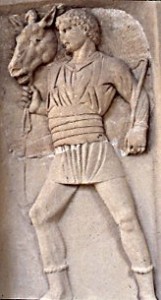
charioteerreliefUnpredictable new things have occurred in society, or at least have emerged in forms unrecognizable to that which has gone before. Such is the case of the charioteer in Ancient Rome.

Top talent on the racing circuit of antiquity attracted throngs of followers, including dignitaries and high officials, wealthy sponsors and fanatics (fans) of all levels of society. The adulation of a sports figures is familiar in our televised age, but in Rome’s day it was something new.

In earlier Greek sport, charioteers were honored along with other athletes (and poets) but Rome twisted the premise.  Roman charioteers were professionals. Instead of glorifying the charioteer for achievement, Roman racing grew into a “win at all costs” spectacle that favored violent confrontation and cutthroat tactics. Ironically this escalation of conflict gave advantage to the lowest levels of society, who would take risks avoided by those of more privileged rank. (This gave no clue to the Roman elite.)
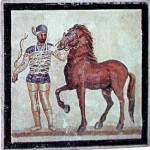
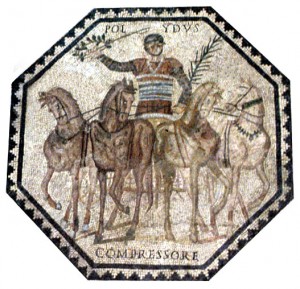
charioteer_mosaicFor their part, charioteers gradually developed an impunity to societal laws and accepted conduct. The profession became synonymous with thuggery, cheating, bribery and other “low” behavior, to the point Emperor Nero “forbade the revels of the charioteers, who had long assumed a license to stroll about, and established for themselves a kind of prescriptive right to cheat and thieve, making a jest of it.” [Suetonius, “The Lives of Twelve Caesars”]

Greek’s held the reins in their hands, but Roman charioteers tied them around their waists which (deliberately?) dramatically increased the danger and fatality of collisions as the pilot was subject to being dragged unless he cut his reins in time.  Whether the spectacle of chariot-racing was a symptom or a cause, Roman societal attitudes became increasingly fatalistic and competitive, and finally merciless and capricious. And then … nothing.

The Greek view of awarding athletes “honor and glory” was replaced in Rome with the material rewards of fame and wealth. We don’t know the names of many Greek chariot-racing heroes; we know more about the celebrated Roman charioteers. However, while Greek racing flourished and developed into a new form, there was no second act for the Roman Circus.

Thundering Echoes of Our Past

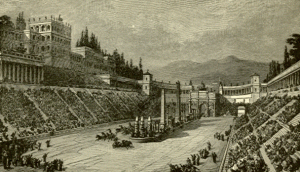
A city is gripped in mania: favored teams of pampered athletes from around the known world are meeting in no-holds-barred competition on the field of sport. Dignitaries and celebrities mingle with major sports figures as throngs chant the names of their favorites. Vast sums are wagered, details of the competition are endlessly debated. A deafening roar signals the start of competition, a scream punctuated with the crowd’s shrieks of pleasure and shock…

polydus2

The scene is of antiquity’s sport of Roman chariot racing, the world’s first mass spectator sport, a spectacle that grew to shake the foundation of social custom and introduced a new kind of fanatic to the world. More than “mere” sport, the passions that chariot racing sparked were a discovery that changed civilization.

The frenzy of today’s mass media sports can be seen in primary colors in antiquity’s great “spectacle of horses.” The star celebrity status of athletes, cheering crowds, widespread coverage, gambling, grand venues and prizes—all the attendant glories of modern televised sport are striking echoes of what has gone before.

The top charioteers and horses were celebrated as iconic heroes: it was grumbled that Rome showed more grief over the loss of a favorite racing team than a military defeat in battle.  The annual Circuit wound from Rome down the Italian peninsula and around the Mediterranean, with the best-known teams clashing at venues in Syracuse, Carthage, Alexandria, Constantinople, Antioch, Athens—bringing color and excitement to the drab lives of the imperial citizenry.

Emotions ran hot in the stands, with winning supporters rioting as losers wept and threw their clothing on the track to wander the streets in despair:

“… a people to whom one need only throw bread and give a spectacle of horses since they have no interest in anything else. When they enter a theatre or stadium they lose all consciousness of their former state and are not ashamed to say or do anything that occurs to them…. constantly leaping and raving and beating one another and using abominable language and often reviling even the gods themselves and flinging their clothing at the charioteers and sometimes even departing naked from the show. The malady continued throughout the city for several days”
~ Dio Chrysostom, c. 200 AD (Orationes, XXXII, LXXVII) describing fan behavior in Alexandria

What was this grandfather of modern televised sports insanity, how did it grow and what were the effects of the passions it released?

Next up: The Charioteers

The Paradox of Horses in War

One thing you notice when researching historical fiction like “Eclipsed by Shadow” is how much human history is owed to the horse. Civilization advanced through adapting to the horse’s outlook.

Horsemanship is a civilized encounter with an alien mind. Horses are a “prey” species whose code is: “he who quickly runs away, lives to run another day.” The horse is perpetually alert, suspicious and ready to flee, and 6000 years of domestication have not changed this basic instinct.

The horse is an unlikely creature to ride into the chaos of battle, yet no animal so conjures the image of war. Horsemanship is one of mankind’s oldest and most perfected technologies, and the battlefield was its testing ground for thousands of years. It would seem an impossible feat to ask a timid, flighty animal to carry men into a smoking, stinking cacophony of fire and noise—yet that is exactly the result needed, and produced.

The Book of Job in Bible has a passage which relates this paradox.

“Hast thou given the horse strength?
Hast thou clothed his neck with thunder?
Canst thou make him afraid as a grasshopper?”

Of course the horse is only an instrument; war is an invention of man. Strangely, the speed and physical strength of the animal made him a formidable weapon, but the great challenge of horsemanship through the ages was how to get this four-legged weapon onto the battlefield at all. Anyone who has seen a horse “shy” or bolt in terror from a blowing leaf will understand the achievement of enlisting cooperation from what is essentially a saddled rabbit.

Skittishness in horses varies between individuals and isn’t completely explainable, as with Saki’s famous “Brogue,” a horse so named “in recognition of the fact that, once acquired, it was extremely difficult to get rid of.” According to the author’s description: “Motors and cycles he treated with tolerant disregard, but pigs, wheelbarrows, piles of stones by the roadside, perambulators in a village street, gates painted too aggressively white, and sometimes, but not always, the newer kind of beehives, turned him aside from his tracks in vivid imitation of the zigzag course of forked lightning.”

The secret of man’s partnership with the horse is trust. A wild band of equines operates through friendships and roles, and with proper instruction the trained horse learns to place his rider in the leadership position. This trust must be earned through the process of schooling, and can easily be lost, but it is one of the miracles of riding that only through an exchange of trust can the incredible potential of a horse’s ability be unlocked.