#49- In the Shadow of the Coliseum

Even in this dark dream, Meagan did not want to see another death. She forgot danger; she reached over the stricken horse and touched the soldier’s arm. The eye in the scarred face fixed on her. The granite look of victory flickered as the crowd fell silent. –Eclipsed by Shadow (excerpt)

THE CROWD BEGAN laughing at the terrified girl clinging to her fugitive mount, the only entertainment remaining. Spectators pointed and mocked her frantic ride. Meagan tried to coax her mount down to a slower pace, but the frightened horse fought every pull. The animal’s breath came in short, explosive bursts. Flecks of foam covered Meagan’s legs.

The crowd’s roar surged as her mount stumbled and pitched. Meagan’s shoulder hit the sand as the horse fell, and she rolled to escape being pinned. She pulled herself to her knees.

The fallen horse lay heaving. Going to the animal’s head, Meagan spoke gently, huddled against the sound of the crowd. Around her were only the dead and dying and panting soldiers leaning on spears. The crowd clamored for more blood, but the sound receded into the background of her mind.

A uniformed man strode towards her and the fallen horse. He wore no helmet and his hair was plastered in sweat. Scars slashed his face, and one slash intersected the place his left eye should have been. The man ignored Meagan and stood over the horse’s head. His living eye was filled with hard passion. She shouted to him but the man did not hear. He was savoring the moment, the glory. He lifted his sword over the horse’s neck.

Even in this dark dream, Meagan did not want to see another death. She forgot danger; she reached over the stricken horse and touched the soldier’s arm. The eye in the scarred face fixed on her. The granite look of victory flickered as the crowd fell silent. The stricken horse lifted his neck and rose in a series of well-timed jerks. Shouts began to rise across the stadium as the pardoned horse jogged stiffly away to find his partner.

The disfigured soldier pulled Meagan to her feet. She half-jogged to keep up with the man’s purposeful strides as he brought her to the side of the arena. On the platform above her, a robed man stood. He waited a moment, listening to the ovation, and thrust his fist into the air.

Excerpted from Eclipsed by Shadow, the award-winning 1st volume of “The Legend of the Great Horse” trilogy. (Hrdbk pg. 116)

Book II: The Golden Spark will be published soon.

Read the 1st Chapter online!

Copyright © 2008 John Royce
#47- Savage Nation

Meagan knelt in her tattered nightgown, barefoot on wet, cement-like flooring. This is not happening, she repeated, keeping her eye on the soldiers. The group was forced to its feet and she was shoved forward with the others. Sweat, garlic and leather mingled with the scent of animals and dung. – Eclipsed by Shadow

.

“HABES SPEM NATANDI!”

An icy blast of water filled Meagan’s eyes and nose. She tripped among wet bodies as she was drenched by another downpour. A crowd of ragged people crouched around her, soaked and shivering within a circle of steel spears. Men in rags stood close with brimming buckets.

Where am I now?

Another bucket was tossed. Meagan gasped under the spray and stood to escape. Metal-tipped points blocked her way. Bronze-helmeted men came closer, shouting furiously at the people cringing within the circle of spears. The prisoners were men and women both, mostly young, and all were filthy and sodden. A few bled diluted streaks into the rags they wore. Sweat, garlic and leather mingled with the scent of animals and dung.

Meagan knelt in her tattered nightgown, barefoot on wet, cement-like flooring. This is not happening, she repeated, keeping her eye on the soldiers. The group was forced to its feet and she was shoved forward with the others. Incredibly, Meagan heard something she understood just as another bucket drenched her. It was a fragment of a language heard only in a classroom, but the words were well-formed and clear: the words were Latin and they meant, you have hopes of swimming.

Soldiers forced the group against a wooden wall until splinters pressed into Meagan’s forearm. Suddenly the wall gave way, swinging open. She was pushed into open space.

Sound rose and shook the air. Filled bleachers banked a vast four-story amphitheatre. Tall masts soared to spread a high awning over the stadium. A moat circled the inner arena floor, and beyond it smooth marble walls were topped with elephant tusks and netting. Cherub-winged boys suspended by rope swooped over white sand and arced high above the audience. Near the opposite end of the stadium, a team of mules was lashed to something dark and slack. It took a moment for Meagan to recognize the shape of an elephant.

Excerpted from Eclipsed by Shadow, the award-winning 1st volume of “The Legend of the Great Horse” trilogy. (Hrdbk pg. 111)

Book II: The Golden Spark will be published Fall 2010.

Read the 1st Chapter online!

Copyright © 2008 John Royce

Horses and the Dark Ages of Man

Horses may have pulled and carried humanity up the long ascent from primitive cultures, but it wasn’t a straight line. Human societies have been subject to cycles of  falling away from civilized life.

“Dark age” describes the lack of historical records from these periods, such as during the Bronze Age collapse about 1200 BC, which ended the Mycenaean culture and extinguished literacy for several centuries.

The most recent “dark age” of Western culture was the approximately 1000 years after the collapse of ancient Rome, or the Middle Ages. The wonders of ancient Rome included heated public Baths,  running water and vast entertainments — the Middle Ages were marked with mud roads, illiteracy, poverty and disease.

What does this have to do with horses?

Horsemanship has been a slow road of progress from brutal subjugation to humane partnership. Understanding the horse, an excitable prey animal, has been a major exercise in empathy for human culture.

A new idea of riding was discovered by the ancient Greeks we now call dressage, which emphasizes the cooperation of the horse rather than forced submission. Dressage develops a harmonious partnership with the horse and provides greater control, balance and athleticism.

This civilized form of riding was lost during the Middle Ages; as humans reverted to illiteracy and brutality their riding became brutal as well.

It’s interesting to note that dressage was one of the earliest classical arts to be reborn in the European Renaissance. The return of humane horsemanship to the world coincided with the birth of the modern era in about the 17th century — not so long ago.

In a sense, good horsemanship is a celebration of empathy, and perhaps a barometer of its presence. Our relationship with the horse started before recorded history, but the goal of humane partnership as practiced today is only a few centuries old!

The Great Horse “Incitatus”

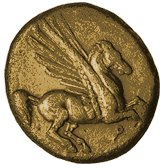
chariot-racing-coinA new review by Mara Dabrishus of the blog Whitebrook Farm mentions Incitatus, a famed Roman chariot-racing stallion favored by the third Emperor Caligula (24-41 AD) to the point of obsession.

The book passage mentioning Incitatus comes during a visit to the strange library of Mrs. Bridgestone, an eccentric woman who has made a collection of evidence about the “Legend of the Great Horse.”

Meagan was stopped before a crumbling box mounted on a low pedestal. The object was corroded and gray from age.

“It doesn’t look it, I know, but that is said to be the remains of the manger of the Roman Emperor Caligula’s favorite race horse, Incitatus. Caligula had a stable of marble and gold built for the stallion, complete with furnishings and servants. Though horses are strict vegetarians, Incitatus was fed mice dipped in butter and marinated squid.” Mrs. Bridgestone added more quietly, “Of course, the man was considered dangerously insane.” [pg 48, Eclipsed by Shadow (pbk)]

Incitatus was said to have never lost a race, and was showered with gifts and honors by the Supreme Leader of Rome. The stallion was given a stable of marble and a manger of ivory, and is said to have been been fed an extreme diet of delicacies (though he reputedly ate only from his bowl of barley mixed with gold flakes.) Dignitaries were “invited” to dine with Incitatus, whose palatial home was furnished with fine art.

Troops were stationed in the neighborhood of Incitatus‘ marble stables before a race to ensure the stallion’s rest, and the Emperor was said to have conducted a long household debate as to whether to marry the horse to secure his dynasty.  In a final insult to the Senate, Caligula planned to make Incitatus a consul of Rome.

After Caligula’s timely death from assassination, Incitatus was reportedly down-graded to a stall in a regular stable without complaint (and probably much relief). Unfortunately Caligula’s corruption was an omen. Rome was able to rid itself of the megalomaniac leader, but never could return to the citizen government of the Republic and escape the insanity of absolute rule.

Naufragia!

Naufragia was the name Romans gave to crashes during a chariot race, the shocking pileups of man, machine and thrashing horses. Naufragia is the latin word for “shipwreck,” which conjures the shocking destruction and tangled ruin that so dismayed—and ultimately delighted—the screaming spectators of the Circus.

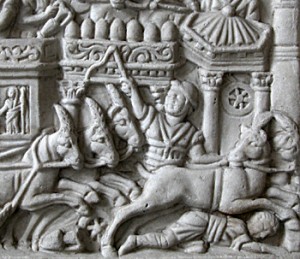
Naufragia-stoneworkNaufragia was ultimate disaster, an end not only to hopes of victory but to lives, careers, destiny. A favorite champion could be undone in an instant—every moment of a chariot race was fraught with potential disaster. The extremes of emotion provoked by collisions and near disasters shocked spectators into wild states of euphoria and despair.
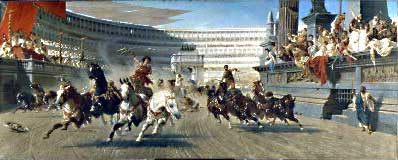
A crash was the ultimate calamity for a chariot, but with the growth of the spectator sport Rome twisted the calamity into attraction. The shock of destruction that punctuated the spectacle drove spectators into frenzy, and became a catharsis for the tensions surrounding the race. Spectators grew addicted to the emotional drama of the Circus, filling their increasingly empty lives with it’s loud distraction as their society declined.

Fate was capricious and all of life was subject to naufragia! Honor, duty, love, courage, all one’s hopes, all effort, all resources—naufragia!—gone in an instant.

Naufragia was the point of distraction. As the lives of ordinary citizens were drained of promise by their darkening Empire—they cheered for naufragia! Deprived of property and rights, they cheered—naufragia! And in the end, distracted, frenzied, caught in its own social dysfunction and spectating madness, Rome itself became the grand metaphor of its own distraction—naufragia!

Chariot Racing Lives!

“The Chariot Race” (1882) by Alexander von Wagner

A goal of mine when writing “Eclipsed by Shadow” was to introduce lesser-known history and discuss it in new ways. Roman chariot racing signaled something new to humanity with far-reaching implications, and it was the phenomenon that made me aware of the central role horsemanship has truly played in the development of civilization.

Ancient Rome is important for its lessons. Western civilization traces its roots to the Greek and Roman societies of antiquity, and those roots are far more than entertaining echoes in our own time. In “Eclipsed by Shadow” I note: “Rome had advertising, taxes, courts and contracts, free market capitalism, corporations, seven-day weeks, holidays, welfare, organized religion, spectator sports, running water and sewers, fine roads, literature, cultural arts, and a well-run military—none of this would save them.”

There was much that was good about Rome in its early centuries. Their society grew the world’s first Middle Class, and instituted a representative form of government complete with a Senate, elected politicians and a system of law. Yet it is the unhappy fact of Rome that they corrupted and became something that destroyed human conscience and pitched Europe into brutal centuries of Dark Ages.  Western Civilization has died once before.

The tragedy of Rome is that they were doomed by forces mankind had never encountered before, because they were something new under the sun. At its height, Rome offered its citizens a standard of living not seen again until the middle 1700’s—more than 12 centuries of brutal squalor in Europe lay between the fall of Rome and the Enlightenment. It is not a path to tread again.

One of the forces that Rome unleashed was fanaticism, and it happened through chariot racing.