Thundering Echoes of Our Past

A city is gripped in mania: favored teams of pampered athletes from around the known world are meeting in no-holds-barred competition on the field of sport. Dignitaries and celebrities mingle with major sports figures as throngs chant the names of their favorites. Vast sums are wagered, details of the competition are endlessly debated. A deafening roar signals the start of competition, a scream punctuated with the crowd’s shrieks of pleasure and shock…
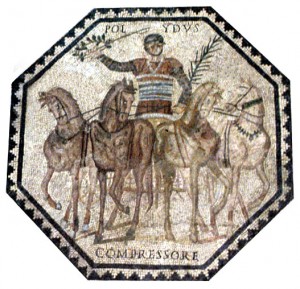
polydus2

The scene is of antiquity’s sport of Roman chariot racing, the world’s first mass spectator sport, a spectacle that grew to shake the foundation of social custom and introduced a new kind of fanatic to the world. More than “mere” sport, the passions that chariot racing sparked were a discovery that changed civilization.

The frenzy of today’s mass media sports can be seen in primary colors in antiquity’s great “spectacle of horses.” The star celebrity status of athletes, cheering crowds, widespread coverage, gambling, grand venues and prizes—all the attendant glories of modern televised sport are striking echoes of what has gone before.

The top charioteers and horses were celebrated as iconic heroes: it was grumbled that Rome showed more grief over the loss of a favorite racing team than a military defeat in battle.  The annual Circuit wound from Rome down the Italian peninsula and around the Mediterranean, with the best-known teams clashing at venues in Syracuse, Carthage, Alexandria, Constantinople, Antioch, Athens—bringing color and excitement to the drab lives of the imperial citizenry.

Emotions ran hot in the stands, with winning supporters rioting as losers wept and threw their clothing on the track to wander the streets in despair:

“… a people to whom one need only throw bread and give a spectacle of horses since they have no interest in anything else. When they enter a theatre or stadium they lose all consciousness of their former state and are not ashamed to say or do anything that occurs to them…. constantly leaping and raving and beating one another and using abominable language and often reviling even the gods themselves and flinging their clothing at the charioteers and sometimes even departing naked from the show. The malady continued throughout the city for several days”
~ Dio Chrysostom, c. 200 AD (Orationes, XXXII, LXXVII) describing fan behavior in Alexandria

What was this grandfather of modern televised sports insanity, how did it grow and what were the effects of the passions it released?

Next up: The Charioteers
Chariot Racing Lives!

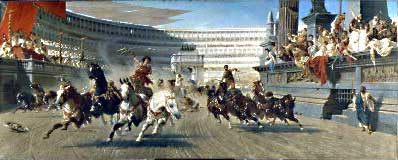
“The Chariot Race” (1882) by Alexander von Wagner

A goal of mine when writing “Eclipsed by Shadow” was to introduce lesser-known history and discuss it in new ways. Roman chariot racing signaled something new to humanity with far-reaching implications, and it was the phenomenon that made me aware of the central role horsemanship has truly played in the development of civilization.

Ancient Rome is important for its lessons. Western civilization traces its roots to the Greek and Roman societies of antiquity, and those roots are far more than entertaining echoes in our own time. In “Eclipsed by Shadow” I note: “Rome had advertising, taxes, courts and contracts, free market capitalism, corporations, seven-day weeks, holidays, welfare, organized religion, spectator sports, running water and sewers, fine roads, literature, cultural arts, and a well-run military—none of this would save them.”

There was much that was good about Rome in its early centuries. Their society grew the world’s first Middle Class, and instituted a representative form of government complete with a Senate, elected politicians and a system of law. Yet it is the unhappy fact of Rome that they corrupted and became something that destroyed human conscience and pitched Europe into brutal centuries of Dark Ages.  Western Civilization has died once before.

The tragedy of Rome is that they were doomed by forces mankind had never encountered before, because they were something new under the sun. At its height, Rome offered its citizens a standard of living not seen again until the middle 1700’s—more than 12 centuries of brutal squalor in Europe lay between the fall of Rome and the Enlightenment. It is not a path to tread again.

One of the forces that Rome unleashed was fanaticism, and it happened through chariot racing.

Show Jumping has a story to tell

I recently watched the live video feeds from two major international jumping events, The Syracuse Invitational and the Royal Winter Fair in Toronto. The horses look great, the riders are skilled, the competition level is high and humane. Both are well-run by innovative management.

The only lack was in the Announcing. Show jumping is like a storybook with pictures: it must be narrated. The story needs to be told.

Those who already love the sport will forgive transgressions against their spectator interests, but that is no reason for complacency. The key to creating new fans is engaging them.

Entertaining spectators at a horse show is as easy as talking to them about horses. This is not “easy” at all, in reality, as it requires talent combined with professionalism and love for horses and the sport. However, it would be pay great dividends for the sport to develop just such talent.

“What’s a Dressage?”

It’s hard not to notice the disdain with which some sports watchers treat Dressage. They give silly quotes to media people that produce articles like: “Olympic dressage events leave Hong Kong’s horse racing fans yawning.”

Well of course they are yawning. You don’t get your Olympic thrills through eventing dressage, which is only more interesting than attractively-drying cement if it’s being done wrong. Olympic thrills are found on the next day, the Cross-County. Someone should have told the spectators, or at least the media. There is so much confusion in the world.

It is actually understandable that equestrian sports are such an oddity to the public, in spite of humanity’s millennia-old partnership with the animal. An uninitiated person would naturally assume modern equestrian sports have all existed since ancient times–in fact some of the most popular and exciting are hardly a century old.

It is an amazing bit of historical timing that an ancient skill like horsemanship was perfected to point it could conceive of athletic sports like 3-Day and Jumping … at the same time as the invention of automobiles. And today we have more horses than ever before.

Dressage, however, is truly as ancient as people assume all horseback riding is. It is a proven method of schooling horses that is at least 2500 years old. The origins were the battlefield, where discipline and athleticism were vital to cavalry success. Dressage is a gymnastics program for developing the horse’s physical abilities, and equally importantly, develops positive state of communication between the horse and rider. The system is utterly humane, to the degree of emphasizing only natural movements and requiring the horse be calm and relaxed at all times. Dressage is, in words of modern culture, the Jedi force that animates horsemanship. It is art, and there is magic in it.

Like all the arts, Dressage was lost with the decay of Western civilization during the Dark Ages. European Horsemanship disintegrated into barbarity as humanity lapsed into bestial conditions. The re-discovery of the ancient Classical art of Dressage was part of the earliest flowering of the Renaissance which sparked our current age.

There are multiple levels of dressage and as the levels go higher, the horse begins to develop more expressively until his gait becomes dancing. Some say dressage is like ballet, and as an educated art it is, though since dressage pre-dates ballet by over a millennium perhaps it is more accurate to say ballet is like dressage. (Dressage is also older than Classical music, that upstart.) The highest standard is the Grand Prix, exemplified in the competitive display of the Olympic Games. High level Dressage is a cultural event, as it was in the original Olympics themselves.

So that judge’s stand only looks like a bookie’s window, racing fans. I think the media gives too little credit to Hong Kong’s citizens. When Dressage is put to music at the final Freestyle, even racing fans may see the sparks which ignited during the Renaissance.