The Road Slowly Traveled: the artist’s view

A scene in “Eclipsed by Shadow” involves a prehistoric horse hunt, with man as the predator. This hunting scene took place in the same era that prehistoric cave paintings were being created, art still visible to us in places like the amazing caves of Lascaux, France.  Even in prehistoric times we have Man the predator … and Man the artist.

Are these the same Man?

Much cave art is utilitarian and crude. Only a few “works” stand out … could it be some artists saw the horse differently — as something to be admired and approached for qualities beyond that of mere food?

If so, the artist’s path was not quickly taken:  mankind crouched and crept through his world for many thousands of years, scrounging a life as both predator and prey. Yet eventually, somehow, the idea of using horses for limited work prevailed, and later the concept of the horse as a partner opened possibilities unknown by our distant ancestors.

It would be hard to argue with the primitive hunter “in the moment.” There is clearly a meal on the hoof, it tastes good: an undefeatable argument. It was a limited, self-serving failure of an argument … but undefeatable at the time! The use of horses cannot happen if your fellow caveman simply kills them.

It mirrors the age-old problem of progress, of mankind bound by its own ignorance and short-term, “greedy” impulses. We have left the caves, but this basic conflict still echoes.

Still, there was a moment when a human didn’t kill a horse he was able to. People did begin to stop hunting/killing horses, and learned better ways of being.

The artists saw the horse as something other than quarry. Art can truly be a window into new reality.

Another outcome …

Strangely, even the best cave art discovered in North America is more crude and hunter-focused than that found in caves of Europe. Illustrated animals in cave art of North America are usually depicted being pierced by arrows.

Horses evolved in North America, but disappeared long before European settlers arrived … and evidence suggests equines may have been hunted to extinction by natives. If so, whether resisted by a more ‘artistic’ view or not, heedless hunting had its way.

Horse-using cultures outstripped others in the development of civilization — American natives were overrun by people who had benefited from their association with the horse. What difference might horse domestication have made to the cultures of the native American had the horse survived … if, perhaps, the artists had won?

There are too many generalizations to make a point, only a question…
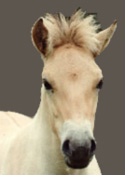
Man and the Prehistoric Horse

The advancement of civilization has required many changes in attitude in mankind, perhaps none more revolutionary than the idea that horses might be our partners. The lesson of prehistoric horses is that our world has possibilities that exceed not our grasp … but our attitudes.

Eclipsed by Shadow begins the story of an accidental journey though history by a young horse-enthusiast named Meagan. The first place she goes (though unknown to her) is prehistoric times … where she finds a band of wild horses.

Evidence exists of man’s earliest relations with horses over 20,000 years ago and, though details of prehistoric times can be murky, something not in reasonable dispute is that prehistoric man hunted horses long before domesticating them.

Horses haven’t changed much since ‘caveman’ times; equines are an ancient species that retain their natural instincts. Cavemen could have harnessed the horses available … yet it took tens of thousands of years to even begin learning how to do so.

Taming horses required a strikingly new attitude, something quite beyond the ‘kill eat food’ pattern prehistoric humans lived by. Once early man did change its outlook on horses, a whole world of possibilities opened that were unimaginable before.

The lesson of prehistoric horses is that the world can have potential that exceeds not our grasp … so much as our attitudes.

The Cave Horse (part 2)

… if nothing else, water was a softer landing than dirt. She took a breath, hitched up her nightgown and gently closed her hands around the horse’s knotted mane. – Eclipsed by Shadow (excerpt)

“A horse got me into this…”

The first thing would be to halter the horse, but Meagan had nothing to use for restraint. “I am not letting you get away,” she whispered to the mare. “I’d never catch you again.” She was positioned on the horse’s right side, of course—the wrong side to mount. Meagan’s next move was bound to be unwelcome.

Mounting in deep water is an old riding trick, or so Meagan had read. The idea sounded logical and, if nothing else, water was a softer landing than dirt. She took a breath, hitched up her nightgown and gently closed her hands around the horse’s knotted mane.

The first broodmare waded out of the water with a snort. This was the signal to depart and each horse ducked its head for a last drink. The little gray horse started back to shore, but before the animal could swing away Meagan pulled herself up and threw her leg over. She clasped her feet around the little horse’s belly and waited for the explosion.

It came quickly.

Excerpted from Eclipsed by Shadow, the award-winning 1st volume of “The Legend of the Great Horse” trilogy. (Hrdbk pg. 97)

Book II: The Golden Spark will be published Fall 2010.

Read the 1st Chapter online!

Copyright © 2008 John Royce

Equestrian Sport and the Next Generation

My 5-year-old niece watched the Rolex Kentucky 3-Day Event this weekend, and she was full of questions:

“Why are they jumping that?”

“Is that a boy or a girl horse?”

“Why do they go one at a time?”

“What’s on the horse’s legs?”

As intensely as she watched, my niece didn’t care about the teams or the scoring. She just loved seeing the horses.

We humans have had a long fascination with watching horses. Chariot racing, dressage, jousting, polo, flat racing are spectacles of past ages, and today newer sports like show jumping, reining and eventing reflect the athletic and humane partnership we’ve developed with the horse.

(This sport with cross-country jumps is still figuring out what to name itself, having been called the Military, horse trials, 3-Day, combined training, and — the name that seems to be winning — Eventing.)

Of course, horses are not part of our everyday lives as in the past. The challenge for equestrian sport today is to explain itself, to welcome the public to enjoy the beauty and excitement of horsemanship.

Probably few people could have guessed 100 years ago, as the horse was being released from the plow and carriage, that a future generation would be still be watching horses — on a box of moving pictures, no less — asking the same questions they had once asked.