“History teaching curriculum failing pupils”

One reason “The Legend of the Great Horse” trilogy is a worthwhile read is its exploration of history in chronological order — with time lines before each new era — as it traces the development in horsemanship in civilization.

A new report from the UK has found students are being ill-served by ‘a curriculum which does not give them a “chronological understanding” of the subject.’

History teaching fails to give pupils proper view of the past, says watchdog:

The Ofsted report said many primary and secondary pupils are being let down by a curriculum which does not give them a “chronological understanding” of the subject …

Schoolchildren fail to grasp how events in history are linked because the subject is taught in “episodes”, an official report has warned….

A “fundamental weakness” in primary schools was that some teachers “did not teach to establish a clear mental map of the past for pupils”.

One reason “The Legend of the Great Horse” trilogy is a worthwhile read is its exploration of history in chronological order — with time lines before each new era — as it traces the development in horsemanship in civilization.

The books of the trilogy convey accurate history in a fun and engaging story …  the books give readers solid overview of history as they ride along with an exceptionally well-written and intelligent literary tale. (For ages 14 and up)
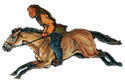
Meagan Roberts, Hero

The heroine of The Legend of the Great Horse trilogy is resourceful, quick-witted and brave … her name is Meagan Roberts.

The trilogy follows the development of horsemanship in human history, and horses have given the world such rugged male icons as cowboys (and indians), knights in shining armor and cavalry charges, not to mention Ben-Hur. Yet my initial main character “Michael” kept dismounting to let Meagan aboard.

The story concerns a modern-day rider, and it is an unfortunate fact that young men in America today do not dedicate themselves to horsemanship in nearly the numbers that young women do … this comes after the majority of human history depicted horsemanship as a strictly male pursuit. Times change and horsemanship changes with it.

Discovering and writing a female hero was natural enough, as my former experience teaching riders meant coaching battalions of young women for every male. My idea for Meagan is the young college student who stays up all night grooming horses in return for a trailer ride to the next day’s competition. Meagan is the excited young girl whose straight-A report card finally convinces a carpool-weary parent to add one more stop at the stables. She is the shy adolescent whose eyes light up with confidence after a good round, the dependable ingénue who quietly keeps herself and her horses glowing, the serious junior who quietly listens and plans her way to success.

Horseback riding has historically been a respected, even hallowed method of youth development, turning out thoughtful, responsible leaders with empathy and depth of character for millennia. Meagan is a compilation of the qualities that horsemanship imparts: she is resourceful, diligent, fair-minded, and brave, and able to lead while engaging in both teamwork and strategic planning. These heroic qualities are all human virtues to be improved in the sandy classroom of our great teacher: the horse.

Equine Benefits: Riding horses is therapeutic and educational

I recently read an inspirational story about an occupational therapist teaching South African street children to ride horses.

The horse has had many roles in our society, some of which have been replaced by technology (eg., transportation, war, food) … however some of the horse’s most important roles in human lives remain vital. Horses are wonderful therapy, as many riders know, and are effective in both intensive rehabilitation and simple therapeutic recreation.

It is exciting to see the spread of horsemanship happening in our technological age, and it signals a recognition that our relationship with our longtime partner is still valued and valuable: a recognition that would seem to credit not only the horses, but also us humans.