Man and the Prehistoric Horse

The advancement of civilization has required many changes in attitude in mankind, perhaps none more revolutionary than the idea that horses might be our partners. The lesson of prehistoric horses is that our world has possibilities that exceed not our grasp … but our attitudes.

Eclipsed by Shadow begins the story of an accidental journey though history by a young horse-enthusiast named Meagan. The first place she goes (though unknown to her) is prehistoric times … where she finds a band of wild horses.

Evidence exists of man’s earliest relations with horses over 20,000 years ago and, though details of prehistoric times can be murky, something not in reasonable dispute is that prehistoric man hunted horses long before domesticating them.

Horses haven’t changed much since ‘caveman’ times; equines are an ancient species that retain their natural instincts. Cavemen could have harnessed the horses available … yet it took tens of thousands of years to even begin learning how to do so.

Taming horses required a strikingly new attitude, something quite beyond the ‘kill eat food’ pattern prehistoric humans lived by. Once early man did change its outlook on horses, a whole world of possibilities opened that were unimaginable before.

The lesson of prehistoric horses is that the world can have potential that exceeds not our grasp … so much as our attitudes.

How to Hunt a Horse

Sneaking around is the rule for horse-hunters… and it ain’t easy. As anyone who has spent time with horses knows, our silent partner is quite alert to potential lions in the flower-pots. The horse’s creed is “he who quickly runs away, lives to run another day,” and he instinctively knows his survival depends upon a good headstart.

Mostly, you don’t.  Horses are prey in the wild, but few predators dare confrontation with a healthy equine. You could call horses “extreme” prey.

stubbs, horse frightened by lion, 1770

The opening historical scene of Eclipsed by Shadow is set in prehistoric times, highlighting the earliest relationship between man and horse: hunter and hunted.

It was not our most enjoyable association, casting humans in the shabby role of trickster … and leaving the horses not too happy either.

The horse has few natural predators

Lions and wolf packs are the only major predators with horse on the menu, and they mostly avoid contact. As a horse’s kick can crush an adult lion’s skull — something we could call a ‘game-changer’ — the horse’s enemies remain on the lookout for immature, elderly or sick equines.

If hooves are the danger in horse-hunting, getting close to the animal is the difficulty. A horse may not have the sprinting take-off of a gazelle, but with a short headstart no predator on earth can catch him.

The horse’s anatomy is a balance between power and swiftness: his heavy body is balanced on thin, well-leveraged limbs that take a few strides to reach full speed but allow him to gallop for miles. The horse simply outclasses all predators at any real distance.

So sneaking around is the rule for horse-hunters … and it ain’t easy. As anyone who has spent time with horses knows, our silent partner is quite alert to potential lions in the flower-pots. The horse instinctively knows his survival depends upon a good headstart.
_______
Copyright © 2010  John Allen Royce, Jr.

Horses and the Dark Ages of Man

Horses may have pulled and carried humanity up the long ascent from primitive cultures, but it wasn’t a straight line. Human societies have been subject to cycles of  falling away from civilized life.

“Dark age” describes the lack of historical records from these periods, such as during the Bronze Age collapse about 1200 BC, which ended the Mycenaean culture and extinguished literacy for several centuries.

The most recent “dark age” of Western culture was the approximately 1000 years after the collapse of ancient Rome, or the Middle Ages. The wonders of ancient Rome included heated public Baths,  running water and vast entertainments — the Middle Ages were marked with mud roads, illiteracy, poverty and disease.

What does this have to do with horses?

Horsemanship has been a slow road of progress from brutal subjugation to humane partnership. Understanding the horse, an excitable prey animal, has been a major exercise in empathy for human culture.

A new idea of riding was discovered by the ancient Greeks we now call dressage, which emphasizes the cooperation of the horse rather than forced submission. Dressage develops a harmonious partnership with the horse and provides greater control, balance and athleticism.

This civilized form of riding was lost during the Middle Ages; as humans reverted to illiteracy and brutality their riding became brutal as well.

It’s interesting to note that dressage was one of the earliest classical arts to be reborn in the European Renaissance. The return of humane horsemanship to the world coincided with the birth of the modern era in about the 17th century — not so long ago.

In a sense, good horsemanship is a celebration of empathy, and perhaps a barometer of its presence. Our relationship with the horse started before recorded history, but the goal of humane partnership as practiced today is only a few centuries old!

Little Horse on the Prairie

The horse is prey and never forgets it: his motto is to ‘run away to live another day.’

The horse is prey and never forgets it: his motto is to ‘run away to live another day.’

Wild stallion Lazarus and part of his band in West Warm Springs HMA, OR | Bureau of Land Management, Office of Public Affairs / Wikimedia / Public DomainHorses are built for speed over distance, and with a good headstart he is safe from his natural predators.

The only hole in the equine’s survival program is the time it takes to reach top speed. To solve this problem horses come “fully-loaded” with highly advanced bio-technology to detect predators.


The Super-Human Horse

An equine’s sense of hearing and smell rivals that of a dog, with additions of swiveling ears and a canyon of a nose that sifts the wind with every breath. Their eyesight is much different than our own, featuring extreme motion-detection ability and a field of vision of almost 360 degrees, with only a few blank spots right behind and in front (which is why you never walk up behind a horse, and why jumping is such a challenge).

Equine abilities extend beyond the human experience. A horse’s legs serve as a sounding board to feel ground vibration, and can even recognize a person by their walk. Horses also have an amazing “photographic” memory and are able to see well at night.

Horses don’t see the world as humans see it

As you ride, the horse has mapped out the robin in the hedge 100 yards away, noted a freshly-painted mailbox and the spot where a dog barked seven years ago … even as feels the rumble of a distant train and responds to your cues.

We don’t share the outlook of horses, the same mind or same senses–we hardly share the same world. Yet somehow, implausibly, a close partnership was made … and is still kept.

Photo: Bureau of Land Management / Wikimedia / Public Domain

_______
Copyright © 2010  John Allen Royce, Jr.

The First (Great) Horse

“The Legend of the Great Horse” trilogy is a journey through history by a modern horse-rider. The story begins with a foal being born to a family with a horse-crazy youngster, Meagan. This horse carries Meagan on an adventure through history.

“The Legend of the Great Horse” trilogy is a journey through history by a modern horse-rider. The story begins with a foal being born to a family with a horse-crazy youngster, Meagan. This horse carries Meagan on an adventure through history.

The new foal, Promise, is actually a Great Horse of legend with the ability to travel back to its previous lives. A mishap occurs and a frightened Promise bolts with her young rider back into time, galloping far into the distant past and leaving Meagan alone with only her horsemanship skills to help her survive.

The first horse of history that Meagan encounters is a small wild broodmare in a band being hunted by humans circa 20,000 BC. The reader knows this, but Meagan must make her own discovery that she has gone back in time.

Now, the wild broodmare isn’t talking (other than time-travel, the story is realistic and fact-based). The mare connects with Meagan through its natural curiosity, an important if perhaps unexpected trait of the species. Meagan remembers her own grandfather’s opinion that horses were the “nosiest animal in Creation.” He called curiosity a fatal weakness of the species … well, that and a fondness for oats.

The fact that a large prey animal would be so naturally curious is part of the mystery of the equine soul, but it is something we share in common. An interesting note is that the horse Meagan meets is not very different in character from the horses she knows from her own modern experience some twenty thousand years later. Horses are a much older species than humans, and their instincts as prey animals still survive.

The independence of the “wild” spirit of horses meant that mankind was forced to adapt to the horse in order to obtain the animal’s strength and speed. It is our genius as humans that we can “see” things from another’s perspective, and it was this ability that made our close partnership with horses possible. In the case of horses, we have not changed them: they have changed us…

The Great Horse “Incitatus”

chariot-racing-coinA new review by Mara Dabrishus of the blog Whitebrook Farm mentions Incitatus, a famed Roman chariot-racing stallion favored by the third Emperor Caligula (24-41 AD) to the point of obsession.

The book passage mentioning Incitatus comes during a visit to the strange library of Mrs. Bridgestone, an eccentric woman who has made a collection of evidence about the “Legend of the Great Horse.”

Meagan was stopped before a crumbling box mounted on a low pedestal. The object was corroded and gray from age.

“It doesn’t look it, I know, but that is said to be the remains of the manger of the Roman Emperor Caligula’s favorite race horse, Incitatus. Caligula had a stable of marble and gold built for the stallion, complete with furnishings and servants. Though horses are strict vegetarians, Incitatus was fed mice dipped in butter and marinated squid.” Mrs. Bridgestone added more quietly, “Of course, the man was considered dangerously insane.” [pg 48, Eclipsed by Shadow (pbk)]

Incitatus was said to have never lost a race, and was showered with gifts and honors by the Supreme Leader of Rome. The stallion was given a stable of marble and a manger of ivory, and is said to have been been fed an extreme diet of delicacies (though he reputedly ate only from his bowl of barley mixed with gold flakes.) Dignitaries were “invited” to dine with Incitatus, whose palatial home was furnished with fine art.

Troops were stationed in the neighborhood of Incitatus‘ marble stables before a race to ensure the stallion’s rest, and the Emperor was said to have conducted a long household debate as to whether to marry the horse to secure his dynasty.  In a final insult to the Senate, Caligula planned to make Incitatus a consul of Rome.

After Caligula’s timely death from assassination, Incitatus was reportedly down-graded to a stall in a regular stable without complaint (and probably much relief). Unfortunately Caligula’s corruption was an omen. Rome was able to rid itself of the megalomaniac leader, but never could return to the citizen government of the Republic and escape the insanity of absolute rule.

Naufragia!

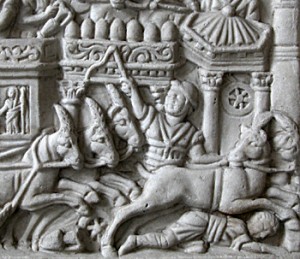
Naufragia was the name Romans gave to crashes during a chariot race, the shocking pileups of man, machine and thrashing horses. Naufragia is the latin word for “shipwreck,” which conjures the shocking destruction and tangled ruin that so dismayed—and ultimately delighted—the screaming spectators of the Circus.

Naufragia-stoneworkNaufragia was ultimate disaster, an end not only to hopes of victory but to lives, careers, destiny. A favorite champion could be undone in an instant—every moment of a chariot race was fraught with potential disaster. The extremes of emotion provoked by collisions and near disasters shocked spectators into wild states of euphoria and despair.
A crash was the ultimate calamity for a chariot, but with the growth of the spectator sport Rome twisted the calamity into attraction. The shock of destruction that punctuated the spectacle drove spectators into frenzy, and became a catharsis for the tensions surrounding the race. Spectators grew addicted to the emotional drama of the Circus, filling their increasingly empty lives with it’s loud distraction as their society declined.

Fate was capricious and all of life was subject to naufragia! Honor, duty, love, courage, all one’s hopes, all effort, all resources—naufragia!—gone in an instant.

Naufragia was the point of distraction. As the lives of ordinary citizens were drained of promise by their darkening Empire—they cheered for naufragia! Deprived of property and rights, they cheered—naufragia! And in the end, distracted, frenzied, caught in its own social dysfunction and spectating madness, Rome itself became the grand metaphor of its own distraction—naufragia!

Chariot Racing Lives!

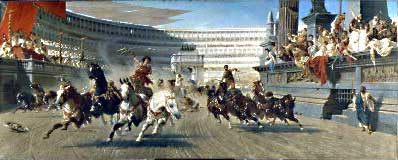
“The Chariot Race” (1882) by Alexander von Wagner

A goal of mine when writing “Eclipsed by Shadow” was to introduce lesser-known history and discuss it in new ways. Roman chariot racing signaled something new to humanity with far-reaching implications, and it was the phenomenon that made me aware of the central role horsemanship has truly played in the development of civilization.

Ancient Rome is important for its lessons. Western civilization traces its roots to the Greek and Roman societies of antiquity, and those roots are far more than entertaining echoes in our own time. In “Eclipsed by Shadow” I note: “Rome had advertising, taxes, courts and contracts, free market capitalism, corporations, seven-day weeks, holidays, welfare, organized religion, spectator sports, running water and sewers, fine roads, literature, cultural arts, and a well-run military—none of this would save them.”

There was much that was good about Rome in its early centuries. Their society grew the world’s first Middle Class, and instituted a representative form of government complete with a Senate, elected politicians and a system of law. Yet it is the unhappy fact of Rome that they corrupted and became something that destroyed human conscience and pitched Europe into brutal centuries of Dark Ages.  Western Civilization has died once before.

The tragedy of Rome is that they were doomed by forces mankind had never encountered before, because they were something new under the sun. At its height, Rome offered its citizens a standard of living not seen again until the middle 1700’s—more than 12 centuries of brutal squalor in Europe lay between the fall of Rome and the Enlightenment. It is not a path to tread again.

One of the forces that Rome unleashed was fanaticism, and it happened through chariot racing.

“On the Rocks” | Horses in Cave Art

This post begins a timeline to discuss the various eras traveled in “Eclipsed by Shadow,” and the rest of “The Legend of the Great Horse” trilogy. The first era is Pre-History.

Man’s long, colorful relationship with the horse is revealed in one of humanity’s oldest creative impulses: Art.  The equine image has adorned virtually every medium of artistic conception throughout history, from prehistoric caves and pottery to paintings, sculpture, music, and literature. Even in our modern automated age, horses have made the successful leap to electronic “new media” of teevee, film and video games.

From a historical perspective, it is fascinating to realize how much retained knowledge of our past is owed to art. The consciousness of a culture is embedded in the art it leaves behind, and artwork is painstakingly preserved for posterity. Horses have stirred human imagination since before recorded history, so art tells the story of horsemanship—and civilization—in a comprehensive visual thread.

The earliest art is the cave painting, and horses are a predominate theme. These prehistoric images give bright glimpses into the shadows of humankind’s veiled beginnings—surviving samples date back over 30,000 years. “Rock art” is famous for depictions of horses and other animals central to the world of primitive man, and some of the prehistoric images reveal genuine artistic quality. The purpose for these drawings is unknown, but various possibilities include the recording or transmission of information, religious ceremonies or superstitious “magical” rites. Whatever the explanation, cave art represent first rays of creative light peering out before the dawn of civilization.

Most cave paintings are crude, but there exist works that rise above mundane scratchings. The most sophisticated and “sublime” cave paintings transcend time, revealing an artistic spirit already intact in pre-historic man. It is as if art truly does touch upon some indefinable and ageless spark of the cosmos. As Pablo Picasso himself said upon viewing the famous Lascaux caves, “We have discovered nothing.”

Copyright © 2008 John Allen Royce, Jr.