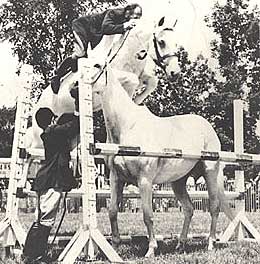
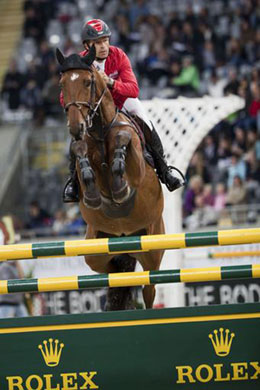
Olympic Show Jumping’s Team Competition: The Nations Cup

Horsemanship mirrors society, and show jumping’s Olympic Nations Cup still serves to measure of the spirit and strength of the countries of the world.

Until the Los Angeles Olympics in 1984, the Nation’s Cup of Show Jumping was the final event held on the last day in the Main Stadium.

The ruling bodies of Olympic sport have currently placed the competition in the middle of the games. The Nations Cup is still of attention for several reasons.

Jumping is recent knowledge

Though equestrian sport is ancient, Jumping is a very young competition. After the first contests were held in the mid-1800’s, it was largely the military that fielded horses and riders–for the very good reason that the highest levels of horsemanship were practiced by cavalry. Jumping was a new challenge in horsemanship that highlighted the best military training.

Officers came together to compete before the public in a team competition that became the Nations Cup. These international competitions originally were much as air shows today: advanced technology of the armed forces. Because cavalry quality often foretold success on the battlefield, there was special meaning attached to national success on the jumping field.

The Olympic Spirit Exemplified

The first formal Nations Cup was held at the Olympics in 1912, and were limited to commissioned military officers until 1952.

Before the Los Angeles Games in 1984, the Olympics concluded with the Nations Cup because it stood for the Olympic spirit of contest through sport and not conflict. The tradition was ended as commercialization took hold and the Closing Ceremonies became more elaborate.

The original meaning of the Nations Cup has not changed however. Horsemanship mirrors society, and the Nations Cup serves as an exciting measure of the spirit and economic strength of countries of the world.

The Nations Cup and Rise and Fall of Nations

Olympic ringsThe placings of the Olympic Nations Cup recall the history of the 20th century. The top teams placings read like a who’s who of the world’s top nations rising and falling from the placings along with their economic and political strength.

The Nations Cup reflects the top of the world

This year’s London Olympic Games are especially interesting as new nations come forward.

South American nations are showing competitive strength. Sweden is asserting itself. Australia is producing top talent. Japan is once more taking part. Eastern Europe is becoming steadily more competitive.

A big story is a new jumping rival in the Middle East, as nations like Saudi Arabia and the UAE have entered the world arena.

Even China and India, not equestrian nations in modern times, are making moves into the Jumping arena …

The Nations Cup has many surprises and excitement. One of the most traditionally important and telling Olympic competitons is set to begin …

Why Horses are part of the Olympics

The 2012 Games of the Olympiad usher in a new four-year cycle, the ancient ritual of our Greek ancestors. After 2700 years horsemanship is still contested in the revival of the Games. Some may wonder why we have horse sports in the Olympics … the answer may surprise you…

The Olympics are coming and I’m seeing equestrian write-ups in media … it’s inspired me to put together some thoughts about the history of equestrian sports and their meaning in the Olympic Games. —  J. Royce
__________________

Olympic ringsThe 2012 Games of the Olympiad usher in a new four-year cycle, the ancient ritual of our Greek ancestors. After 2700 years horsemanship is still contested in the revival of the Games. Some may wonder why we have horse sports in the Olympics … the answer may surprise you.

The Ancient Greeks

Western civilization began with the idea of the ancient Greeks to find a new way forward, by seeking harmony with nature through reason. As brief as this society was (before again succumbing to war), their moment of artistic creation brought an explosion of discovery—theater, geometry, philosophy, astronomy, democracy, medicine, even the empathetic horsemanship we call dressage—which gave inspiration to a new kind of living as men and not beasts.

This spark, interrupted and corrupted and renewed, has grown to spread throughout the world. The society we live in is the living expression of these ancient ideals.

The original purpose of the Olympics

The original Games began as an effort in unity, to honor mankind’s impulse for striving without the disaster of actual conflict. This was a reaction to just such disaster: at the time of the original creation of the Games (c. 760 BC), the Greeks were recovering from the destruction of their society in an 500-year Greek Dark Age.

No culture in history has revered the horse more than ancient Greek society, and horsemanship of the time was a warrior’s skill. So when our ancestors of Western Civilization established a celebration of martial skills in a new spirit of contest, the transformation of the horse from war engine to artistic, athletic partnership was a clear symbol of the promotion of harmony and peace … upon which it was believed the gods themselves smiled.

Equestrian sports symbolize the spirit of a people

Equestrian sports exercised what the Greeks considered the virtues of man, not only wisdom but Aristotle’s 8 moral virtues: prudence, justice, fortitude, courage, liberality, magnificence, magnanimity, temperance. Horsemanship represents reason taming chaos: moral man is granted the crowning seat of nature the brute could never attain.

The celebration of the horse’s athletic partnership with mankind also memorialized the idea of the horse as a gift from Creation. For the ancients, the spectacle of equestrian sport offered proof of the gods’ approval of mankind’s place as leader of the natural world.

The tradition continues

Time has proven the success of the ideals that sparked Western civilization. When mankind has remembered the path of cooperation and humility before Creation, society has unfolded amazing wonders of peace and prosperity. A symbol of this path is today as it was from the beginning: the harmonious union of horse and man, able to achieve together more than could be accomplished apart.

Our remembering of this union, our renewed celebration through equestrian sport, does more than recall the ages past … it ennobles us in the ancient tradition of cooperation and harmony that made the success of civilization possible.

Related Links

» Daily schedule of the Ancient Olympics

» History of the Olympic Games

» The Dark Age of Ancient Greece

» Before the Greek Dark Age

Timeline of Horsemanship: Prehistory

>> see more Prehistoric Cave Horse images [Photobucket slideshow]

The earliest beginnings of mankind echo through artistry preserved on rock walls, giving silent testimony to the creative impulse inherent in mankind … and evidence that our fascination with the horse is older than history.

Eclipsed by Shadow excerpt from “Prey” (20,000 BC)

What if the dream—Meagan sat up quickly and stared at her surroundings. She was still in her nightgown, perched on a rocky cliff over an expanse of prairie grassland. An empty landscape spread before her, basking in late afternoon sun. This is strange, Meagan thought, swallowing. Solid rock walls rose on either side of her, marbled with green moss and snaking black fissures. Nothing manmade was in sight… >> read moresee all Excerpts

Eclipsed by Shadow is the 1st book of ‘The Legend of the Great Horse‘ trilogy, an award-winning adventure through history — on horseback!

Related Writing by John Allen Royce, Jr.
Relevant Links
Further Reading
THE CLAN OF THE CAVE BEAR by Jean M. Auel
Earth’s Children, Book One   [Fiction]

Why I Write about Horses

It can be hard to write about horses and not be misunderstood. Most people seem decided about horses one way or another (mostly another), and conventional “wisdom” I’ve known tends to dismiss horses and their activities as outdated and obsolete.

The misunderstanding is understandable: we humans have always been a few flakes short of a bale when it comes to our equine partner … the writ-large story of horsemanship is one of human ignorance staggering toward a cooperative path it wants nothing of, until some innovation in cavalry tops the ridge and a new way is more or less happily accepted (mostly much less).

When I tell people I’m writing a fiction adventure about horses in history, reactions vary. Some smile in a rush of good feelings and memories (these we call ‘horsepeople’), some are intrigued; other’s eyes dart away with a short nod and change of subject, or peer at me curiously trying to grasp why a grown man would spend time writing about ‘horsies.’

Horse Talk

Well, I don’t write about ‘horsies’ — no author does — but about an animal, a force, that has been an essential partner in civilization. I write to honor the intangible spirit in horses which sparks humanity’s creative impulses, a spirit which has served as mankind’s inner guide by providing a concrete image of noble humility, courage and selfless service. Discussions about horses deal in ideas that created the cultures we live in and have succeeded. Horse talk is really about humanity.

We can speak about horses in bold terms and not be embarrassed: it is hard to find expressive terms to describe how close and longstanding man’s partnership with the horse truly is. History has moved to the sound of hoofbeats since prehistoric man enshrined horses on cave walls, and celebration of our partnership has ennobled mankind throughout recorded time.

Is the great ride over?

Is mankind ready to dismount and proceed into the terrifying future alone? This is a graver decision than the attention it is given.

Yes, we have machines to replace buggies and hoofed cavalry … but perhaps we should consider the lessons of the countless cultures that rested upon the status quo of their horsemanship–and were overridden by newly-discovered potential in the horse.

Today horsemanship’s ancient roles of youth development, leadership training and community-fostering deserve examination, and there are exciting new roles to explore in horse-powered ‘green’ commerce, recreation, and healing so relevant to our crowded future.

It may even be that the ancients were correct in believing the horse was a gift of the Creator, and the future belongs to horsemen as much as did the past.

My answer to skeptics? Horse talk is more than it seems.

The Sports of the World Equestrian Games Represent the History of Civilization

The World Equestrian Games (WEG) are the largest sporting event in the US this year … the featured competitions offer an intriguing and dynamic look at the history of civilization.

Driving: An echo in time

Mankind’s first records are seen in prehistoric cave paintings over 20,000 years old, and are filled with images of horses … even so, humans apparently didn’t start taming and using horses until about 6000 years ago.

It seems logical that riding bareback would be humanity’s first act of horsemanship … so naturally we probably didn’t. According to the most reliable evidence yet found, instead of riding horses, humans spent the first thousand years or so of horse ‘domestication’ fooling around with straps and restraints hitching horses to various carts to begin the activity we call Driving.

The fooling around got much more serious with the invention of chariots which, besides giving us empires like the Hittites and ancient Egypt, eventually treated antiquity to a peculiar insanity called ‘chariot racing’ that became the world’s first mass spectator sport.

By the time civilization emerged from the ensuing Middle Ages, driving had spawned a fleet of vehicles from wagons and buggies to carriages and coaches, with a similarly varied lineup of horsepower’s namesake, including the beer-truck pulling Clydesdale and high-stepping roadster pony.

The modern sport of Driving distills this ancient knowledge into a multi-phase event which includes precision and teamwork in an amazing and picturesque display of horsemanship. Every buckle and strap has not just a purpose, but represents a centuries-long pedigree of trial-and error testing … in seeing Driving at the World Equestrian Games (WEG), we are watching one of mankind’s oldest and most valuable technologies.

Endurance: The marathon of horsemanship

The sport of Endurance at the WEG will cover a 100-mile distance in one day … this feat is a sane result of much prior historical insanity, and the results would have amazed the horsemen of old.

Evidence remains sketchy, but at some point several thousand years ago, after an epoch of attempts to harness a horse without choking it (with varying success), the idea occurred to dispense with the cart and mount up. Early riders apparently sat back on the horse’s hindquarters; nose rings were an early misfortune, and military imagination did not extend beyond leading the horse into battle as a kind of mobile archery platform — but evidence shows early riders were indeed faced forward to the front of the horse, so a good start was made.

Progress came slowly to man’s early cultures, which seem to have preferred the route of dying out rather than updating an opinion. New ways to steer the horse were ironed out eventually, even if learning to stop the animal may have taken an extra millennia or so. Chariot-using Empires of Old preferred ground-rumbling war machines to the simpler virtues of mounted riders, perhaps on the basis of a rider’s vulnerability to being squashed by said chariot. Nomads took up the slack and began the fruitful cycle of raiding settlements, settling down themselves, and being wiped out by other nomads in a few years time.

Nomads may be the answer to why the champion of distance is the Arabian horse, a fountain of equine beauty and “hot” blood. Stamina and endurance were likely of value in surprising sleepy villagers — or escaping wide-awake ones — and to accomplish great distances between watering holes. Legends formed around remarkable feats of endurance, especially about the Arabian breed. Such boasts were perhaps nodded to politely, though not quite believed, until stopwatches and measured courses gave proof in the envelope-pushing sport of Endurance.

Dressage: humane school for horses

Horses are herd animals willing to follow a sound leader, but ancient humanity strenuously avoided this knowledge: the binding-down method seems to have been more the flavor of the day.

Ancient Greece gives evidence of a break with that tradition, advancing the notion that the horse was an individual instead of mere emotive force. Our Western forebears engaged a method of training that emphasized cooperation and harmony that still flourishes today in the noble art, science and sport of Dressage.

Even the earliest appearances of dressage were as an exhibition art, one whose spark helped kindle the original Olympic flame. Despite its artistic character, the most compelling reason for dressage’s early success was the improvement it gave cavalry through greater control of one’s mount.

The empathetic methods of dressage were lost with the fall of Rome and destruction of ancient Western Civilization, and horsemanship returned to brutal methods for the long sleep of the Middle Ages. Ancient writings of Xenophon, a Greek general who wrote about dressage, were discovered in the 15th century and led to a revival of this equestrian discipline. Dressage was one of the first rediscovered Classical arts of the Renaissance.

The arena became a laboratory for studying methods of training the horse, whose results spread to different forms of horsemanship: the famous Spanish horsemanship of the Conquistador era, ancestor of the WEG sport of Reining, resulted from the rediscovery of Classical dressage.

Dressage competition at the WEG is contested at the highest level, and a more modest test is part of the Eventing competition. Every level in dressage proceeds through ancient principles, most of which exist fundamentally unchanged from the times of the Greeks. The beauty of a horse schooled in dressage comes from the encouraged expression of the horse’s natural movements, so the horse’s motion remains organic and natural at its core.

Modern dressage seen at the WEG is a celebration of humane partnership with the horse, honoring our ancient partner and displaying the triumph of cooperation and harmony over more ‘physical’ methods.

Vaulting: putting the Pommel Horse to shame

The equestrian sport of Vaulting dates from whenever man decided handsprings off horses was worth the hospitalization cost. In all seriousness, vaulting is an ancient entertainment: there is reference to such horse acrobatics in the Iliad. Horse acrobats were very popular in antiquity.

The Latin word for a vaulter was a desultor or ‘one who leaps down’ … between the Coliseum and Circus (chariot racing) intermissions, the crowds of the ancient ‘developed’ world kept such equestrian gymnasts in constant demand.

Compared to the active performance partnerships of other horse sports, the horse seems incidental to the action here, but there is a direct link. Every vaulter must be intimately aware of the status of the horse at all times — his speed, direction, balance and mental outlook — which is the essence of a horseman’s skill.

Show Jumping: ‘To Fly without Wings’

Moving to the next WEG sport on human history’s timeline, we must pass over the medieval era in which Jousting was the new equestrian pastime, and arrive at an activity which served to rescue horsemanship from obsolescence after the invention of the combustion engine: Jumping.

Just as the horse’s role as transportation was being replaced by technology in the early 20th Century, horse jumping exploded onto the world scene and drove a new recreational wave of horsemanship.

Jumping was first discovered and practiced in the mid-to-late 1700’s as a way to continue hunting despite the Enclosure Laws in Britain, which mandated the fencing of English farmland. Daredevil riders found that some horses were willing and talented jumpers, and events were arranged to show buyers the aptitude of their sale horses for this new activity. The sport might have been called Sale Jumping and not be technically misnamed.

As a result, Show Jumping has the distinction of being created specifically as a spectator attraction: the original ‘leaping’ competitions that began in the early 1800’s were set in a field; when spectators complained they could not see the rides, the jumps were moved into an enclosed area and a new sport was born.

Today Jumping has grown into a world-wide sport with millions of competitors and supporters. The game is simple to understand: competitors begin a set course with zero “faults” … a knockdown counts 4 faults, refusals by the horse or exceeding the time limit cost additional penalties, and a fall is elimination. The size of the fences is a factor, and also the distances between, since a horse’s depth vision is limited and the rider must set the pace and stride.

Interestingly, the spirit of medieval Jousting lives on in Jumping, and not only as a clash between mounted riders, or for the danger involved, nor the colorful spectacle, or even that nobility “VIP’s” repose in catered boxes while mere peasants spectators get cheaper seats or just grass to sit on. Top Jumping riders follow in the footsteps of medieval “free lance” knights, who traveled from match to match in pursuit of awards, fame and prize money (though not necessarily in that order).

International competition such as the WEG also provide a distant mirror of medieval times, when a hapless King facing a battle would put out a call to assemble the “free lances” of his kingdom to bolster his troops and face the enemy: today national jumping teams are formed from top individual horses and riders that come together not so much as an interdependent team, but as the strongest force a nation can muster.

Eventing: ultimate test of horse & rider

Besides Show Jumping, another sport grew from the military, one designed as a challenge for the ideal cavalry horse. The sport has grown in the past century and is or has been known by several names — The Military, Horse Trials, Combined Training, 3-Day Events — which have distilled to the happy noun of: Eventing.

The competition is divided into three phases: Dressage, Cross-Country and Stadium Jumping. In competition such as seen at the WEG, each phase is held on a separate consecutive day — hence the older name, 3-Day Event. (The first phase of Dressage is often held on two days, to add to any possible confusion.)

The first phase (Day 1) tests the horse/rider partnership’s communication and obedience with a Dressage test on the flat … it mimics the parade grounds or drill exercises of cavalry troops. The second phase (Day 2) is the singular specialty an Event horse can claim: the Cross Country. Originally intended to test the skills of a cavalry mount as a courier — crossing the county quite literally — this unique challenge of galloping a course of solid fences over varied terrain including water, ditches, banks, drops, and various combinations is the soul of Eventing, and one of the most spectacular spectacles in sport.

The final phase (Day 3) is the Stadium Jumping, a winding course of jumps set in an arena over knockable fences. The purpose of the this final phase is to show the horse’s stamina, soundness and willingness to persevere.

In recent years Eventing has followed in Show Jumping’s hoof beats, establishing a World Cup circuit, greater prize-money and an increased profile. Eventing will be one of the most exciting spectator attractions of the WEG.

Reining: equestrian sport’s new spin

Reining can be called a form of equine acrobatics, and is a new horse sport only recently added to the WEG program in 2002.

Reining may be seen as the mixing-in of dressage principles with the horsemanship of the Old West, or perhaps what happens when the needs of the cowboy and the training of a cow horse become a form of popular art. Sound principles of dressage are evident in a well “reined” horse, most especially the calm communication and focus on the horse’s movements.

However, reining pushes beyond what the horse would naturally offer, executing crowd-pleasing extreme movements such as the spin and sliding stop. The flashy hair-trigger response of the Reining horse demonstrates reflex obedience and set movements, rather than being purely a focus on the horse’s expression itself, as in dressage.

ParaDressage: spotlighting a new role for the horse

In recent years, horses have been proving therapeutic in many ways: in physical therapy programs, for emotional rehabilitation, to uplift the disadvantaged, and here, as seen in WEG competition, to physically free a human from disability. Aboard a horse, the disabled may be equal to all … a vivid example of the freedom the horse has always offered mankind.

It’s a big year for this vibrant emerging field of horsemanship: riding by the disabled is the newest sport at the WEG. The “para” in Para-dressage means a contest run in “parallel” to regular equestrian sport — different degrees of disability are separated to allow meaningful competition with others of the same physical limitation. Therapeutic roles are recent for the horse, and offer new possibilities for the future of horsemanship.

The Amazing Journey has not Ended

The historical tour of horse sports contested at the WEG travels from still-living sports created long ago to new modern competitions of advanced riding, and comes to ParaDressage and the potential to go further into the future. The 2010 World Equestrian Games represent an evolution in horsemanship, a coming together of horse enthusiasts and the chance to spread the love of horses while growing something new for humanity.

Return to Blog’s Home Page
Historical Notes: Leaving the Prehistoric world behind …

In Eclipsed by Shadow, the first book of “The Legend of the Great Horse” trilogy, young Meagan Roberts takes the ride on a prehistoric wild horse … that’s just how things were between horses and humans 20,000 years ago.

In Eclipsed by Shadow, the first book of “The Legend of the Great Horse” trilogy, young Meagan Roberts takes the ride on a prehistoric wild horse. (excerpt of the scene)

According to fossilized bones and cave paintings, that’s just how things were between horses and humans 20,000 years ago.

Our clear understanding of the distant past remains shrouded by the passage of time, but there are two important facts we can know about prehistoric horses:

1) Horses have always been with us. Early man spent many thousands of years watching, stalking, hunting … and painting horses. The horse has been part of humanity’s story since the very beginning.

2) It took thousands of years for primitive humans to even begin to learn to use horses to assist in work. Man’s journey from the caves required a change in attitude to seek forms of cooperation, away from seeing horses as only a form of prey. This new outlook took an amazingly long time to happen, especially considering that it was so tangibly rewarded by a horse’s willingness to share his strength with mankind.

Perhaps we can’t know details about how mankind’s attitude toward horses shifted from meal to tamed beast — but the change is a case of old ways of thinking being replaced by new and better ideas. In this way, horsemanship is a living demonstration that cooperation brings new possibilities to human life and can open entire new worlds.
_______
Copyright © 2010  John Allen Royce, Jr.

The Road Slowly Traveled: the artist’s view

A scene in “Eclipsed by Shadow” involves a prehistoric horse hunt, with man as the predator. This hunting scene took place in the same era that prehistoric cave paintings were being created, art still visible to us in places like the amazing caves of Lascaux, France.  Even in prehistoric times we have Man the predator … and Man the artist.

Are these the same Man?

Much cave art is utilitarian and crude. Only a few “works” stand out … could it be some artists saw the horse differently — as something to be admired and approached for qualities beyond that of mere food?

If so, the artist’s path was not quickly taken:  mankind crouched and crept through his world for many thousands of years, scrounging a life as both predator and prey. Yet eventually, somehow, the idea of using horses for limited work prevailed, and later the concept of the horse as a partner opened possibilities unknown by our distant ancestors.

It would be hard to argue with the primitive hunter “in the moment.” There is clearly a meal on the hoof, it tastes good: an undefeatable argument. It was a limited, self-serving failure of an argument … but undefeatable at the time! The use of horses cannot happen if your fellow caveman simply kills them.

It mirrors the age-old problem of progress, of mankind bound by its own ignorance and short-term, “greedy” impulses. We have left the caves, but this basic conflict still echoes.

Still, there was a moment when a human didn’t kill a horse he was able to. People did begin to stop hunting/killing horses, and learned better ways of being.

The artists saw the horse as something other than quarry. Art can truly be a window into new reality.

Another outcome …

Strangely, even the best cave art discovered in North America is more crude and hunter-focused than that found in caves of Europe. Illustrated animals in cave art of North America are usually depicted being pierced by arrows.

Horses evolved in North America, but disappeared long before European settlers arrived … and evidence suggests equines may have been hunted to extinction by natives. If so, whether resisted by a more ‘artistic’ view or not, heedless hunting had its way.

Horse-using cultures outstripped others in the development of civilization — American natives were overrun by people who had benefited from their association with the horse. What difference might horse domestication have made to the cultures of the native American had the horse survived … if, perhaps, the artists had won?

There are too many generalizations to make a point, only a question…

Man and the Prehistoric Horse

The advancement of civilization has required many changes in attitude in mankind, perhaps none more revolutionary than the idea that horses might be our partners. The lesson of prehistoric horses is that our world has possibilities that exceed not our grasp … but our attitudes.

Eclipsed by Shadow begins the story of an accidental journey though history by a young horse-enthusiast named Meagan. The first place she goes (though unknown to her) is prehistoric times … where she finds a band of wild horses.

Evidence exists of man’s earliest relations with horses over 20,000 years ago and, though details of prehistoric times can be murky, something not in reasonable dispute is that prehistoric man hunted horses long before domesticating them.

Horses haven’t changed much since ‘caveman’ times; equines are an ancient species that retain their natural instincts. Cavemen could have harnessed the horses available … yet it took tens of thousands of years to even begin learning how to do so.

Taming horses required a strikingly new attitude, something quite beyond the ‘kill eat food’ pattern prehistoric humans lived by. Once early man did change its outlook on horses, a whole world of possibilities opened that were unimaginable before.

The lesson of prehistoric horses is that the world can have potential that exceeds not our grasp … so much as our attitudes.

The Cave Horse (part 2)

… if nothing else, water was a softer landing than dirt. She took a breath, hitched up her nightgown and gently closed her hands around the horse’s knotted mane. – Eclipsed by Shadow (excerpt)

“A horse got me into this…”

The first thing would be to halter the horse, but Meagan had nothing to use for restraint. “I am not letting you get away,” she whispered to the mare. “I’d never catch you again.” She was positioned on the horse’s right side, of course—the wrong side to mount. Meagan’s next move was bound to be unwelcome.

Mounting in deep water is an old riding trick, or so Meagan had read. The idea sounded logical and, if nothing else, water was a softer landing than dirt. She took a breath, hitched up her nightgown and gently closed her hands around the horse’s knotted mane.

The first broodmare waded out of the water with a snort. This was the signal to depart and each horse ducked its head for a last drink. The little gray horse started back to shore, but before the animal could swing away Meagan pulled herself up and threw her leg over. She clasped her feet around the little horse’s belly and waited for the explosion.

It came quickly.

Excerpted from Eclipsed by Shadow, the award-winning 1st volume of “The Legend of the Great Horse” trilogy. (Hrdbk pg. 97)

Book II: The Golden Spark will be published Fall 2010.

Read the 1st Chapter online!

Copyright © 2008 John Royce

How to Hunt a Horse

Sneaking around is the rule for horse-hunters… and it ain’t easy. As anyone who has spent time with horses knows, our silent partner is quite alert to potential lions in the flower-pots. The horse’s creed is “he who quickly runs away, lives to run another day,” and he instinctively knows his survival depends upon a good headstart.

Mostly, you don’t.  Horses are prey in the wild, but few predators dare confrontation with a healthy equine. You could call horses “extreme” prey.

stubbs, horse frightened by lion, 1770

The opening historical scene of Eclipsed by Shadow is set in prehistoric times, highlighting the earliest relationship between man and horse: hunter and hunted.

It was not our most enjoyable association, casting humans in the shabby role of trickster … and leaving the horses not too happy either.

The horse has few natural predators

Lions and wolf packs are the only major predators with horse on the menu, and they mostly avoid contact. As a horse’s kick can crush an adult lion’s skull — something we could call a ‘game-changer’ — the horse’s enemies remain on the lookout for immature, elderly or sick equines.

If hooves are the danger in horse-hunting, getting close to the animal is the difficulty. A horse may not have the sprinting take-off of a gazelle, but with a short headstart no predator on earth can catch him.

The horse’s anatomy is a balance between power and swiftness: his heavy body is balanced on thin, well-leveraged limbs that take a few strides to reach full speed but allow him to gallop for miles. The horse simply outclasses all predators at any real distance.

So sneaking around is the rule for horse-hunters … and it ain’t easy. As anyone who has spent time with horses knows, our silent partner is quite alert to potential lions in the flower-pots. The horse instinctively knows his survival depends upon a good headstart.
_______
Copyright © 2010  John Allen Royce, Jr.