Eclipsed by Shadow review: “With each turn of the page a new adventure awaits”

With ECLIPSED BY SHADOW, John Royce has created a wonderful legend sure to please historians and equestrians alike. Jammed packed with chariot racing, jousting and action galore one wonders how one book can hold so much. With each turn of the page a new adventure awaits.—Angela Simmons, Review the Book

The following is a new review of Eclipsed by Shadow by Angela Simmons for Review the Book:

Angela Simmons | Review the Book

Owning a horse was the only thing that teenager Meagan Roberts could think about. Owning a legendary great horse never crossed her mind.

In “Eclipsed by Shadow”, we see that Meagan’s horse, Promise, is just that. Unwilling to heed the advice of Mrs. Bridgestone, the keeper of the legend, that if this Great Horse is rode it would bring darkness, Meagan rides Promise.

Instantly she is transported to another place and time. 20,000 B.C. to be exact. She finds herself among a tribe that is hunting horses. From there chaos ensues as she is chased off a cliff with a herd of horses. Before falling to the bottom of the canyon, the Great Horse comes to her aid, and Meagan finds herself in the middle of a battle in the Black Sea. Running for shelter she finds herself in the middle of an ancient tomb.

Along the way Meagan makes friends and enemies while she collects knowledge. Also, she witnesses the cruelty of each place she comes to. Meagan wonders why her beloved Promise, who is so sweet and gentle, could bring her into so much darkness. After helping the Emperor’s chariot driver, Braedin, win the races, she realizes that unintentionally she has brought disgrace upon the Emperor. Once again she finds herself in a fight for her life.

The Great Horse now transports her to the year 1240 A.D. She finds herself among the Tartars and Genghis Khan as they raid and pillage each village they come to. Meagan escapes with her only friend, a pony she named Targa. Once again chaos follows…

With “Eclipsed be Shadow,” John Royce has created a wonderful legend sure to please historians and equestrians alike. Jammed packed with chariot racing, jousting and action galore one wonders how one book can hold so much. With each turn of the page a new adventure awaits.

graphic image of knight chesspiece

Eclipsed by Shadow is the first book of the award-winning fiction trilogy, The Legend of the Great Horse, a journey through history–on horseback! The story follows the time-travel adventure of a modern horsewoman lost in the distant past.

Further information about this unique and imaginative ‘creative non-fiction’ novel can be found at TheGreatHorse.com.

Targa the Mongolian Warpony

Eclipsed by Shadow, is the first volume of the new trilogy adventure, “The Legend of the Great Horse,” which begins a journey that traces the history of horsemanship. In the story, the heroine, Meagan Roberts, is taken back through time by her horse, Promise. Meagan must survive humanity’s brutal past armed only with her knowledge of advanced horsemanship of the 21st century.

One of the interesting things about our relationship with horses is how slowly it developed. For many millennia mankind struggled with “conquering” the horse, when in reality simple humane treatment and empathy was the path to tapping into the equine potential. Today’s sensibly schooled horses could literally canter circles around primitive man’s poorly “broken” and brutalized mounts.

In the story, Meagan is dropped off in various time periods and must fend for herself. One such era is during Europe’s Dark or Middle Ages, when the enlightened horsemanship of Greek antiquity has been forgotten and brutality was again the norm of the day.

"Mongolian Steppe" by David Edwards | National Geographic
“Mongolian Steppe” by David Edwards | National Geographic

It was in this era that Mongolian nomads burst from their ancestral homes on the Asian plains to pillage and ransack from Russia to Poland, throughout India and the Middle East. Meagan lands amidst the united armies of Genghis Khan and is given a Mongolian warhorse mare she names Targa.

The mare is typical of her breed: stocky, short-legged and pony-sized. Meagan succeeds through empathizing with the mare and employing modern riding techniques that provide strong yet humane guidance. Their association grows into a real horse-rider partnership.

Targa illustrates how unchanged the horse’s nature is after many millennia of human “domestication.” Horses are simply too old a species to have become more than superficially adapted to mankind’s demands. Targa responds to Meagan’s enlightened empathy as horses do today; horses of primitive man would have done the same if given the opportunity.

The rampaging Mongolians cherished their horses, and their horses responded. This responsive cooperation with their riders led to wiping out alien societies, but there was no malice in the Mongolian warponies. Despite talk of the military “genius” of Genghis Khan, had Western society remembered their enlightened horsemanship instead of traveling down the path of war and brutality, they likely would not have been overrun by the superior skill of their Asian raiders.

There are many lessons in history, but one of the foremost is how spectacular are the results of empathy and harmony.

The Long, Colorful Road of Horsemanship

The Legend of the Great Horse traces horsemanship from its earliest beginnings. The premise of the story is that Meagan, a horse-interested teenager of modern day, is whisked back in time to relive history … on horseback. As she travels in “jumps” from the earliest days of man’s association with horses, Meagan and the reader experience the changes in horsemanship that mirrored the advance of civilization.

A hallmark of skilled modern riding is that it looks “easy,” but it has not always been this way. The casual spectator watching well-groomed horses cantering a jumping field or half-passing down the centerline may be forgiven believing things such as “the horse is doing all the work” or “anyone could do it” etc. Riding looks easy when done well because the rider remains in balance with the horse, maintaining a fluid rhythm with the mount’s athletic motion. This is not how horsemanship has looked through most of history, and nothing we now take for granted about riding was obvious or simple for humans to discover.

The "Greek Seat"
The “Greek Seat”

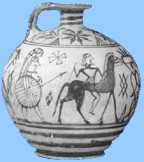
The origins of horseback riding are lost in the mists of time, but using the horse to pull wagons, carts and chariots represented the first phase of practical horsemanship. Mounted horsemanship does not appear in clear view until antiquity, and after at least 3000 years of development it wasn’t terribly impressive. The horses were guided with nose-rings by a rider who sat far back toward the horse’s hindquarters, though the Greeks modified this by inching forward to sit on the middle of the horse’s back. It literally took the human race thousands of years to discover where, exactly, to properly sit on horseback.

To humans, horses possess an alien mind, and what seems obvious today was not “obvious” at all. As one example, stirrups were not invented until after the fall of the Roman Empire—which itself was more than 25,000 years from the days that prehistoric man’s preoccupation with the animal was shown by painting in caves. First came a “toe loop” which developed in India (c. 500BC) for the holding of the rider’s big toe. A few centuries later nomadic “Sarmatians” of southern Russia and the Balkans invented a single stirrup for use in mounting. Over the next half-millennium, Asia brought the stirrup to fruition; it was copied by Europeans and revolutionized war.

One might consider that our ancestors were not the most clever ponies in the stable, but the reason for the long period of development was that advanced horsemanship required changes in mankind’s thinking. As humanity grew sufficient empathy to discover advanced horsemanship, the modern world also began a rapid transformation into the modern age.

The Pegasii

The flying horse Pegasus is one of Western culture’s most popular and durable myths. What may be surprising to many is that the idea of a winged horse is not isolated to Greek mythology, but is a universal notion in ancient religion.

The theme of my new trilogy, The Legend of the Great Horse, is the depth of man’s partnership with horses and the animal’s foundational importance to civilization. When discussing the influence of horses it is almost impossible to throw too wide a net, and the legend of a winged horse is an example.

Pegasii
Pegasii

Early Christianity was combined with the Sun-worshipping belief that the Emperor departed earth upon his death in a chariot pulled by winged immortal horses, and various beliefs herald the Second Coming of Christ upon the winged horse Avatar. Islam records the gift to Adam of the winged horse Mamoun. Hindus honored Vivasvat, the Seven-Headed Sun Horse that symbolized the workings of the Seven Chakras. Buddha was said to have flown across the heavens as a white horse, and both Norse and Celtic religions had a stableful of supernatural mounts.

In modern times, mythology is remembered as a group of fantasy stories involving the gods of Olympus and exotic animals like the Chimera, Basilisk, Hydra, along with soaring Pegasus. But in the time of their practice, the “mythology” of the Greeks was their religion: a complex, inter-woven, often conflicting world enmeshed with the natural. The gods lived upon Mt. Olympus: their home could be seen by Greek villagers carrying on their daily lives.

Today’s popular conception of mythology is a pale summary of the original. We may have learned that Pegasus was a gift from the gods, or that the flying horse was the mount of Zeus with hoofbeats which caused thunder. But it is less remembered that the first gift of a horse was rejected by the people of Athens in favor of Athena’s offering of an olive tree, one of antiquity’s great examples of the wisdom of choosing butter (olive oil) instead of guns (cavalry). It is forgotten in popular imagination that that Pegasus sired a race of immortal winged horses, the Pegasii; or that Pegasus had a brother named Celeris, the mount of one of the Geminii twins (Castor, “The Horseman”) who were honored as a cult by the legions of Rome, and given placement, as was Pegasus, in his own constellation: The Colt.

The immortal Pegasii were of many colors, not only white, and they had varying powers of transport and appearance and purpose. The Pegasii were associated with dreams and inspiration, and all were benefactors of mankind or agents of the natural world.

The “legend” of Eclipsed by Shadow and the rest of The Legend of the Great Horse trilogy concerns the strangely universal idea that horses were gifted to man by the Creator. The “Great Horses” of history are descended from this first horse. Promise, the Great Horse belonging to the book’s main character, Meagan, shares the essential characteristics of the Pegasii.