The Bright Side of the Dark Ages: Stirrups!

“It is surprising that horsemen took 1,500 years to think up something so simple. One is reluctantly driven to the distasteful conclusion that we are not really a very bright set of people.”–Charles Chenevix-Trench (1914-2003), A History of Horsemanship

____________

0579_haniwa-horse_c550AD_225pxOne positive thing about the Dark Ages was that horseback ‘barbarians’ invaded, pillaged, and burned using a new development that today we call stirrups–an innovation that revolutionized cavalry and greatly eased saddle-soreness.

Stirrups increased cavalry’s effectiveness against infantry and allowed for the creation of new heavy cavalry with lances. Horses could be ridden faster and for longer distances: the gallop is easier for the animal if its rider stands in stirrups, and stirrups make trotting much more pleasant.

People had ridden in saddles for over a thousand years without stirrups, and the intellectual tone of the era makes it likely people would have gone another thousand without the bracing illustration of an arrow-spewing nomad bearing down at a fast gallop. The device was quickly copied and by 600 AD were spreading throughout Europe.

The Greatest Revolution in Horsemanship … Just Happened!

Even devout horse-lovers may not appreciate how much horsemanship has transformed in the past century. After thousands of years, our relationship to horses and new-found concern for their welfare is a revolution from practices of only a few decades past.

Horse pulling Plow (1939) USAEven devout horse-lovers may not appreciate how much horsemanship has transformed in the past century. After thousands of years, our relationship to horses and new-found concern for their welfare is a revolution from practices of only a few decades past.

The 20th Century saw broad fundamental change to society … as it always has, horsemanship holds a mirror to cultural upheaval and growth.

The Horsemanship Century … a complete transformation

Over the past century, the world has undergone a massive change from using the horse in war, transportation and farm work … to sports, recreation and therapy.

A hundred years ago in 1912, early “High Wheeler” automobiles were being replaced by the Ford’s Model T, or the “Tin Lizzie.” In 1912 tractors were being introduced to American farms; and, though the horse and mule population continued to increase for another 6 years to reach some 26.4 million animals in 1918 … 30 years later horses had almost vanished from the farm.

This steep, rapid decline brought the idea that horses are ‘obsolete’ … the horse-and-buggy has become a metaphor of old-fashioned ways ‘dying out.’ Yet an amazing thing happened that changed the picture of the horsemanship’s anticipated decline: recreation and sport. In the 1800’s jumping was discovered to be an exciting and humane challenge: modern equestrian sports ignited ancient passions for riding and created a new world of horsemanship experience. Even now frontiers in healing horsemanship are opening, providing therapy and rehabilitation for a range of human disabilities.

There are an estimated 9,500,000 horses in the US today, but the horse population is no longer farm animals and cavalry: the demographic has been completely transformed. Our increased focus on equine welfare–almost unseen in earlier human society–is a hallmark of our new ways of horsemanship. The horse helped build civilization, and, amazingly, our modern partnership has risen to new levels with potential to continue into an even brighter future.

_____________
Related Links:

Early American Automobile Industry 1894-1929) Pics of 1912 “High Wheeler” and other contemporary autos … vintage shots of vehicles from 1894 to 1929.

History of Horse-Powered Farming in America A look back at the history of farm horses from Colonial times to the modern horse-farming movement today.

The First Horse …

Every horse in the world can be traced to a single mare that trotted the earth about 130,000 to 160,000 years ago, according to findings reported by Bloomberg News as published by US National Academy of Sciences.

The Cave Mare from "Eclipsed by Shadow"Ancestral Mother of All Horses Galloped 160,000 Years Ago

Today’s horses are descended from one ancestral mare according to findings reported by Bloomberg News as published by US National Academy of Sciences.

Every horse in the world can be traced to a single mare that trotted the earth about 130,000 to 160,000 years ago, scientists discovered for the first time.

The research identified 18 different genetic clusters that arose from the ancestral mare, suggesting that domestication occurred in many places across Europe and Asia, according to work published today in the Proceedings of the National Academy of Sciences.

The Academy’s proceedings did not immediately confirm whether the Ancestral Mare was the original Great Horse as detailed in the nearly-eponymous trilogy of same … or whether this discovery offers new proof of the story’s mysterious legend.
_____________

Related Link:

» All modern horses trace back to single ancestor

Timeline of Horsemanship: Prehistory

>> see more Prehistoric Cave Horse images [Photobucket slideshow]

The earliest beginnings of mankind echo through artistry preserved on rock walls, giving silent testimony to the creative impulse inherent in mankind … and evidence that our fascination with the horse is older than history.

Eclipsed by Shadow excerpt from “Prey” (20,000 BC)

What if the dream—Meagan sat up quickly and stared at her surroundings. She was still in her nightgown, perched on a rocky cliff over an expanse of prairie grassland. An empty landscape spread before her, basking in late afternoon sun. This is strange, Meagan thought, swallowing. Solid rock walls rose on either side of her, marbled with green moss and snaking black fissures. Nothing manmade was in sight… >> read moresee all Excerpts

Eclipsed by Shadow is the 1st book of ‘The Legend of the Great Horse‘ trilogy, an award-winning adventure through history — on horseback!

Related Writing by John Allen Royce, Jr.
Relevant Links
Further Reading
THE CLAN OF THE CAVE BEAR by Jean M. Auel
Earth’s Children, Book One   [Fiction]

#62- The Time Jump

NOTHING HARMLESS FEELS so much like dying as having one’s breath well and truly knocked out. Heaving for air without result, Meagan fought panic as she waited for a breath. When it finally came, she leaned onto her hands and panted in great gulps. – Eclipsed by Shadow (excerpt)

NOTHING HARMLESS FEELS so much like dying as having one’s breath well and truly knocked out. Heaving for air without result, Meagan fought panic as she waited for a breath. When it finally came, she leaned onto her hands and panted in great gulps.

Genghis KhanSounds of men came through the darkness, their speech fast and urgent. Meagan steadied her breathing and listened as words rose and fell around her, foreign words spoken in crisp, rapid strokes. The voices approached and hands gripped the fabric of her tunic, inspecting, pulling at the folds and letting them go.

A light colored horse was led forward, a faint apparition glowing in the darkness. Meagan reached out a hand and ran it along familiar contours. It was a pony, a short but fully grown equine. She was lifted and pushed onto the pony’s back, where she instinctively reached for the reins lying low on the animal’s neck. The stadium and chariots had evaporated into the night air. The last Meagan remembered was the rush of white wings, and the world seemed to melt and reassemble into new solid forms. Now Rome was a memory.

A knot of horsemen rode past Meagan. She could see faces in the light of the torches they carried, Asian faces, parched and grim in the flickering redness. Her pony mount swished its tail impatiently, and Meagan automatically reached to pat the animal’s shoulder. Her hand felt an irregular patch in the hair, and she leaned over to see. Branded on the shoulder, barely visible in the torchlight, was a crescent symbol over a circle.

Voices were receding into the night. Meagan allowed the pony to join the sound of hoof beats flowing through the warm darkness. All she cared to know was that she had moved closer to her own time—so far, there was no evidence. One thing was certain: she was not yet back home.

Excerpted from Eclipsed by Shadow, the award-winning first volume of “The Legend of the Great Horse” trilogy. (Hrdbk pg. 179)

Book II: The Golden Spark is available! Book III announcements coming soon…

Read the 1st Chapter online!

Copyright © 2008 John Royce

Book I: The horse with a demon’s name

ECLIPSED BY SHADOW | 'The Legend of the Great Horse' trilogy book cover (90x135px)

This excerpt is from Eclipsed by Shadow, Book #1 of The Legend of the Great Horse trilogy, an adventure through history―on horseback.

The scene is set in ancient Rome (100 AD): Meagan meets the Emperor’s infamous chariot horse, Cerberus …

“Now that no one buys our votes, the public has cast off its cares; the people that once bestowed commands, consulships, legions, and all else, now meddles no more and longs eagerly for just two things
—bread and circuses.”

—Juvenal (c. 60-140) Roman satirist

THE CHARIOT DRIVER stood and offered his hand. “Would you like to see Cerberus? I will give you the honor.” His handsome smile was warmth in the cold air. “My name is Braedin.”
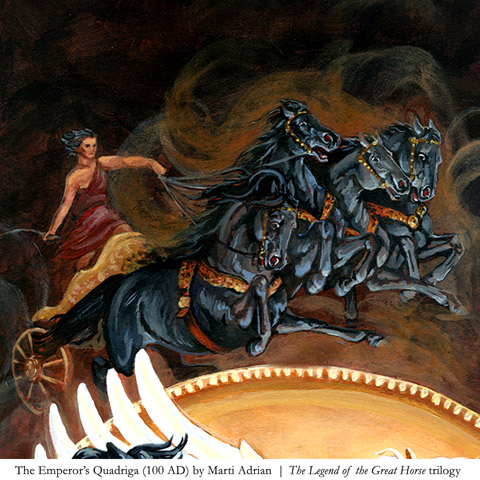
The Emperor's chariot team (100 AD) ... from Eclipsed by Shadow, Book #1 of THE LEGEND OF THE GREAT HORSE trilogy: (c) Micron Press. Illustration by Marti Adrian.She took his hand casually, but the heat of his grasp went through her. “Braedin! I like that. My name is Meagan. They rhyme, sort of … Meagan, Braedin.” She bit her tongue to stop talking.

Together they walked out of the compound, past the curved hindquarters of the marble horses protecting the gates. Beyond them, the outline of buildings topped the surrounding hills, a moonlit cityscape framed by stone. Hard-packed road passed between a circle of pens and an adjoining work-shop. Inside could be seen a shadowy row of neatly stowed chariots.

They passed the workshop area and approached the paddocks. Out of the darkness a stallion’s scream pierced the night air. A horse charged the fence. The driver smiled as dirt flew around him and announced, “The warrior Cerberus!”

Meagan watched in disapproval. “Horses do not have to be like this, Braedin. You would be amazed what some carrots and a nice bridle can do.”

The driver watched the angry stallion with admiration. Hooves smacked against the wood fence in front of him. “The greatest son of Pegasus, the Thundering Horse of Jove! If I had three more like Cerberus our team would win without challenge!”

“Actually Braedin, I think you would have four dead horses.”

“You are wrong. Were the others as strong as mighty Cerberus, he would pull with them. Cerberus is a warrior. He only hates weakness.”

Common horse sense told Meagan that the stallion only hated rivals, but she decided against pressing the point. Instead she watched a small shadow dance toward them in the moonlight, approaching with a comical jig. A goat came up to the fence and shoved his wiry neck through the timber poles, hoping for a handout. It is not uncommon for a horse to bond with a smaller animal, and a transformation came over the stallion as he sniffed his tiny companion. Meagan reached to pet the goat and Cerberus laid back his ears. She stepped back. “So, they do not fight because this is a strong warrior goat? I mean, the horse does not hate everything. You can see he has a nice side.”

“We are not interested in the stallion’s nice side,” the driver said sharply. “Cerberus is not the Emperor’s favorite stallion for his nice side.”

This is the Emperor’s favorite?”

“Yes. From the day Cerberus savaged Titus’ Blues and scattered them across the track. A glorious day.”

Meagan made herself stay silent.

“It was the same month the horse became a centenarius!” The charioteer’s voice was a boast. “Emperor Trajan gave orders that Cerberus would always run in his team. Trajan was a general of the legions, and Cerberus is to represent the military strength that now rules Rome!” The boast died. “Of course, that was many months ago. And many horses.”

“I am sorry, what is a ‘centenarius?’”

“A horse that has won a hundred races. I drove Cerberus to half of those victories before he became too fierce.” His voice grew boastful again. “One of my fans is a poet named Martial. He gave me an epitaph for when I am killed.” The driver stood straighter and recited: “Here lies Braedin, the glory of the roaring Circus, the object of Rome’s cheers and her short-lived darling. The Fates, counting not years but victories, judged me an old man.”

Meagan listened appreciatively. “That is very nice, Braedin, for when you are killed.” She watched the goat grazing quietly by the stallion. At least the horse was not insane, she realized, ending doubts. “I think Cerberus wants friends. Horses do, you know.”

Eclipsed by Shadow (Book #1 of the trilogy) won national awards including the Eric Hoffer Award for best Young Adult Fiction, and the Mom’s Choice Award for best family-friendly Young Adult Fantasy.

__________

Links:

» See All Excerpts from The Legend of the Great Horse trilogy.

» Read the 1st Chapter online.

» See the Media Kit for more information about the trilogy.

» Order Books

gend of the Great Horse trilogy books (2015)

#57- The Chariot Driver

When the driver did not leave, Meagan sat up straighter. Maybe some Romans were friendly, she thought. One shouldn’t judge based on a few. “Have you been a driver very long?” – Eclipsed by Shadow (excerpt)

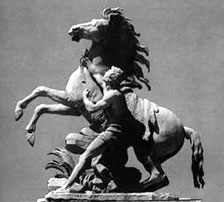
The Horse Tamer from Marly-le-Roi

A lone shape approached from the shadows of the barracks. “Of an evening!” the dark figure called. “May I join you?”

“Of course!” Meagan called back. Horace usually retired early, but she would be glad of his company.

Instead it was the Emperor’s chariot driver who approached. He knelt, two eyes shining in the moonlight. “Are you planning your place among the stars?”

She swallowed, unable to think of anything sensible to say in English, much less Latin.

“I have seen you here before. You like this little grove. Are you a worshipper of wood nymphs?”

“Oh, I am. They are so clean.” When the driver did not leave, Meagan sat up straighter. Maybe some Romans were friendly, she thought. One shouldn’t judge based on a few. “Have you been a driver very long?”

“All my life. I have driven three seasons for the Emperor. I drove Cerberus to his greatest victories.”

“Did you say ‘Sir-Bearus?’ Is that one of the horses?”

The driver laughed. “I do not mean the demon hound that guards Hades! Of course Cerberus is a horse!”

“Oh,” Meagan said politely. “You named a horse after a demon?”

“Yes, the three-headed dog-beast who devours all who try to escape the Underworld.” The driver spoke with admiration. “Our stallion Cerberus does the same to any who try to pass him.”

“I see,” she answered, trying to sound impressed. Then she asked casually, “have you seen any new black horses lately … say, a really tall mare?”

“We keep no mares in the Emperor’s stables,” the driver said curtly. “We favor stallions.” He lowered his voice. “I wonder, how does it feel to know the time of your death?”

A flash of panic went through her. “Well, I do not know that yet.”

“The Festival of Mars begins in six days. Are you not sad, not miserable?”

“I suppose.” Meagan felt a chill beyond the cold. “Are you trying to be nice?”

The young man’s teeth shone in the moonlight.

Excerpted from Eclipsed by Shadow, the award-winning 1st volume of “The Legend of the Great Horse” trilogy. (Hrdbk pg. 138)

Book II: The Golden Spark will be published soon.

Read the 1st Chapter online!

Copyright © 2008 John Royce

Curse Tablets of Ancient Rome … or, No Wonder our Driver is not Feeling his Best!

Almost all of our modern ideas on history and mankind have been anticipated in Greek & Roman thought … human nature has not changed enough to make knowledge of our ancestors obsolete.

Almost all of our modern ideas on history and mankind have been anticipated in Greek & Roman thought … human nature has not changed enough to make our ancestors’ knowledge obsolete.

We can recognize our common (if unsavory) humanity in the prevalent Curse Tablets of ancient Rome, which were inscribed on thin lead tablets and hidden in advantageous spots … chariot racing was a hotbed of sabotage and curse tablets.

Here is an actual Roman curse typical of the day:  ‘I command you, demon, and demand from you this hour and day and moment, that you torture and kill the horses of the Greens and that you kill in a crash their drivers.’

Other authentic Curse Tablets were more elaborate and featured detailed instructions:

‘I conjure you, holy beings and holy names, to join in aiding this spell, and bind, enchant, thwart, strike, overturn, conspire against, destroy and kill the charioteer and all his horses tomorrow in the circus at Rome. May he not leave the barriers well. May he not be quick. May he not outstrip anyone. May he not make the turns well. May he not win any prizes, and if he has pressed someone from behind, may he not overtake him; but may he meet with an accident; may he be bound, may he be broken; may he be dragged along by your power, in the morning and afternoon races.

Superstition is an ancient custom and, then as now, not always a pleasant one.

#56- The Emperor’s Quadriga

THERE IS MORE to chariot racing than its appearance of runaway horses, Meagan soon learned. The game was more about survival than speed. Charioteers rode as upon a galloping skateboard, using their weight to change direction. Communication with the horses was limited to slaps and pulls.

Of course, the true horseman’s challenge of chariot racing was in keeping the animals sound. The most popular chariots were teams of four horses, the Quadrigas, which meant sixteen delicate legs exposed to overreaching and missteps, apart from the disaster of collisions. Because of these risks, chariot horses were not raced until five years of age.

As spring took hold the workout track was swamped with spectators hoping for a glimpse of the Emperor’s team. Ajax and Saxon were now sound, with only bare spots to mark their injuries. Trotting out with floating strides, the recovered Saxon was applauded for his beauty. With his large eyes and dished profile, the sleek stallion resembled an Arabian, the oldest pure breed of horse. He had been born in the fiery deserts of Persia, and each year a fleet of mares sailed the fabled stallion’s blood back to his homeland. Indeed Saxon had one of the most beautiful heads Meagan had ever seen, if the horse would only stop tossing it.

Ajax was a special favorite of the guards. The men stiffened in salute whenever the stallion jogged past, as if to a wartime hero. The short-backed, burly horse had been raised in a barracks in Gaul. He was trained to a simple, brutal code, and was eager in the extreme.

The stallion Cerberus was a daily spectacle, scattering grooms into his flocks of admirers. The Emperor’s infamous favorite had been born free in a Greek village’s semi-wild band of horses. In his youth the stallion had been allowed to choose his mares peacefully, but when the new Emperor Trajan’s preference for black horses was made known the stallion had been hauled away to Rome. It was clear from the stallion’s flashing limbs and teeth that Rome was not forgiven.

Excerpted from Eclipsed by Shadow, the award-winning 1st volume of “The Legend of the Great Horse” trilogy. (Hrdbk pg. 145)

Book II: The Golden Spark will be published soon.

Read the 1st Chapter online!

Copyright © 2008 John Royce

#55- Stranded in Ancient Rome

When she was not being reprimanded or ordered about, Meagan was generally considered not to exist. – Eclipsed by Shadow (excerpt)

Lost in the year 100 AD…

When she was not being reprimanded or ordered about, Meagan was generally considered not to exist. The fact of her station was impressed upon her by the Emperor’s driver. Handsome and popular, the young man was a celebrity. Well-dressed businessmen accompanied the star athlete at all times, and groups of admirers waited for him outside the courtyard gates. The first time Meagan saw the gray-eyed driver, she gave him a nervous greeting. The driver strode past her without the slightest acknowledgment.

Someone did notice her, however. The scarred soldier, Horace, came to talk whenever he saw Meagan in the courtyard. Sometimes he would be gone for days and reappear with a new limp or nasty cut. “These scratches?” he would say, joking. “I get them training. Careless of me.”

At first the man’s hulking presence frightened her, and she avoided looking at the dried, shriveled place where his eye should have been. Still, his was the only friendship Meagan could claim, and she learned simply to look at the eye that was looking at her and to avoid the map of scars.

“You take many baths,” the soldier told her one day. (Actually, he pantomimed the splashes Meagan took in the courtyard’s fountain.) “You are so clean. Not like the others.”

She smiled and nodded, her usual response to the language. Classroom Latin had not stressed conversation.

Horace bent down to unlace his sandal and nudged it towards her with a mud-spattered toe. “Like my new sandals? I got them from a Macedonian cobbler. Good, no?” The man flipped the sandal over to show an underside studded with iron nails. “They have hobnails too, for a practical Roman. It saves the soles.”

Meagan nodded blankly.

Horace sighed and picked up his sandal to show her. “Sandalio,” he said in a good-natured baritone, and knelt to lace it. He stood and plucked his garment. “Tun-i-ca.”

“Oh! Your tunic is …” Meagan searched vainly for an adjective.

“Elegans,” Horace prompted her, grinning. Then he held up his thick fingers, counting patiently, “Unus, duo, tres…”

With his eye-patch, Horace was remotely handsome in a mashed sort of way, and Meagan tactfully encouraged him to wear it. Regardless, when Horace made her laugh she found it easy to forget his imperfections. Soon Meagan forgot academic Latin terms such as imperfect and present tense—words that described imperial Rome quite well—and instead rehearsed the names of things explained by Horace.

Excerpted from Eclipsed by Shadow, the award-winning 1st volume of “The Legend of the Great Horse” trilogy. (Hrdbk pg. 129)

Book II: The Golden Spark will be published soon.

Read the 1st Chapter online!

Copyright © 2008 John Royce